Article III in the series “From Image to Geometry”
What color is water? The more obvious the answer seems, the more interesting it becomes to examine what exactly we take for granted.
On a school map the sea is blue. In a glass, water is almost colorless. In a mountain river it can be milky white; in a peat lake, dark brown; in a shallow bay, turquoise. In one symbolic system Water is coded blue, in another white. Jung connects water with the unconscious and with maternal imagery. In Khakas material, water becomes a road, a boundary between worlds, and an image of origin.
If we gather all of this into a single dictionary, we get an impressive bag of associations.
That is precisely the way of reading we want to test.
The second article in this series ended with a hypothesis: a symbol can outlive its own explanation, and when a tradition breaks, the image is often preserved better than the verb of relationship. Now that idea has to be tested on one concrete symbol.
Water is almost ideal for such an experiment. Its physical properties are simple enough, its cultural meanings extraordinarily diverse, and its symbolic history so rich that any weak definition quickly falls apart.
1. First, an Awkward Literal Question: Is Water Actually Blue?
Yes — but not as simply as it seems. The U.S. Geological Survey notes that pure water has a faint intrinsic blue tint: water molecules absorb the red part of the visible spectrum more strongly. In a small volume the effect is barely noticeable; through a large depth of water it becomes visible. [1]
Natural water, however, is almost never laboratory-pure. Suspended sediment, organic matter, minerals, algae, depth, bottom color, and lighting can shift the observed color from brown and green to turquoise, milky, or almost black. [1]
So even physically, the question “what color is water?” already has two levels.
- There are properties of the water itself.
- And there are properties of the medium through which and in which we see it.
We will need this distinction later.
Not every property of an image belongs to the object itself.
2. Color Is a Powerful Code, but a Poor Candidate for the Archetype
Color is extremely convenient for a tradition. It is instantly recognizable and easily transferred into clothing, ornament, a map, a ritual object, or a diagram. This is why color correspondences can be remarkably persistent.
But persistence of a code does not make it fundamental.
In working material drawn from Tatiana Kobezhikova’s oral seminars, Water is described in a range from pale blue to transparent white, while Air is blue and sky-blue. [2] In our authorial deck this choice is made even more sharply: Water is coded white, Air blue.
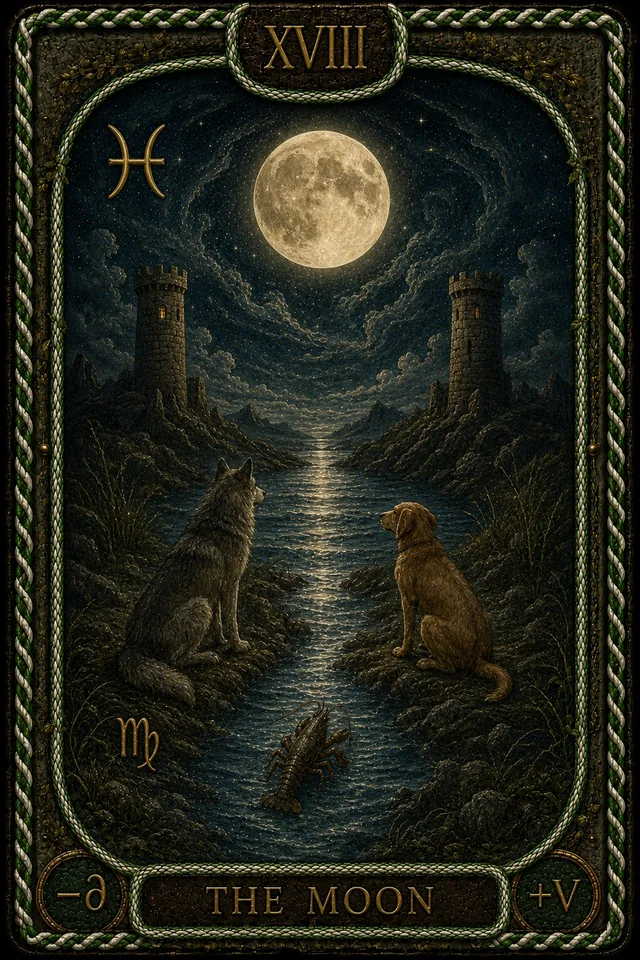
At the same time, on the Moon card the depicted water itself remains blue. And this is a useful contradiction.
The white braid says: “which structural element is operating here?”
The blue surface says: “what does nocturnal water look like in this particular scene?”
One color is a code of the model. The other is a property of the depiction.
If these levels are mixed, an endless argument begins over which color of water is “correct.” Separate them, and the argument disappears.
3. An Independent Case: Khakas Water as Path and Boundary
Ethnographic material offers a much stronger test than comparing two occult tables, because here we have an independent tradition.
In Venariy Burnakov’s study, water in the traditional Khakas worldview appears simultaneously as a road into other worlds and as a boundary between being and other-being. It is linked with the image of land-and-water, fertility, the feminine principle, motherhood, and homeland. [3]
Notice how poorly this reduces to the popular formula “Water = emotions.”
A road is not an emotion.
A boundary between worlds is not an emotion.
Maternal origin is not merely emotionality either.
Yet another kind of kinship appears between them.
Water receives a path.
It carries.
It connects one place to another along the current and at the same time separates one bank from the other across the current.
It can become a medium of birth because it holds content inside a changing shell.
What begins to emerge before us is no longer a word but a geometry.
4. The River: The Object Changes, the Path Remains
A river is one of the best natural images of an invariant precisely because its substance is constantly being replaced.
The water that was here yesterday has already moved downstream. The bank can change. The channel can shift. The water level rises and falls.
And yet we continue to speak of the same river.
What exactly is being preserved?
Not the molecules.
Not an exact boundary.
Not a single color.
What is preserved is an organized trajectory: source, channel, direction, watershed, sequence of transitions, and the relation between the previous and the next state.
In the authorial model of From Metaphor to Geometry, this becomes one of the central properties of Water: the external objects of experience may change, while the form of the trajectory persists; the present depends on the path already traveled. [8]
The book’s short formula is: Earth — what is retained; Water — what continues; Air — what connects; Fire — what changes. [8]
5. Why Fluidity Alone Is Not Enough
Here the first danger of an attractive metaphor appears.
If we say “Water is everything fluid and shape-changing,” then clouds, smoke, language, markets, the internet, and conversation instantly fall into the element of Water.
But many of these phenomena are closer to Air in our model.
So a more precise boundary is needed.
In the basic square of the elements, Water and Air really are alike in one respect: neither has a rigid boundary of its own. Both media can take on an external form.
The difference lies in the second coordinate.
Water: −∂, +V. Air: −∂, −V.
Water does not retain its own boundary, but it preserves internal content. Air retains neither its own boundary nor an internal volume: its strength lies not in carrying a filled interior, but in establishing connection between separate regions. [8]
This distinction works surprisingly well in ordinary examples.
| Case | What Is Preserved | Geometry |
| A river changes its banks | trajectory and flow of content | Water |
| A translator connects two languages | route between separate regions | Air |
| A person carries a habit into a new job | form of state and history of response | Water |
| A messenger delivers a message | address and channel of connection | Air |
| A family moves but preserves its way of life | internal rhythm through a change of shell | Water |
| A social network connects strangers | connectivity without a shared interior | Air |
Water now stops being a synonym for fluidity. It acquires a specific invariant: content is carried through a change of form in such a way that the history of the transition remains causally significant.
6. Water Is Not Emotion. Emotion Is Only One of Its Carriers
Popular esotericism often makes a convenient move: the four elements become four psychological categories, and Water receives feelings.
That correspondence is not useless. But it is too narrow.
If Water is the higher principle of internal state, memory, adaptation, duration, repetition, and phase transition, then emotion is only its most visible special case. [8]
We can recognize water-structure even where there are no intense feelings at all:
- in a habit carried from one situation into another;
- in the body’s adaptation to repeated strain;
- in a family way of life preserved after moving;
- in the atmosphere of a team living through a change of leadership;
- in a professional pattern of response that a person brings into a new role;
- in cultural memory that preserves the form of a story after the original explanation disappears.
If the definition works only for emotions, it explains too little. If it explains the trajectory of a state at different scales, it begins to have a chance of being generative.
7. Memory Is Not a Warehouse but a Change in the Probability of the Next Step
It is easy to imagine memory as an archive: experience was recorded and lies stored inside.
For the water model, another picture is more useful.
The path already traveled changes the probability of the next transition.
A person who once had a painful experience speaking in public enters the next audience from a different starting state.
A team reacts differently to an ordinary failure after surviving a severe crisis.
A child who repeatedly receives a calm response to fear gradually returns to equilibrium more quickly.
Here memory need not be recalled in words. It is already built into the form of the next state.
This is why the book describes Water through the dependence of a future transition on the history of the trajectory — through something that resembles hysteresis in mathematical language. [8]
Water does not merely carry the past. It makes the past part of the geometry of the next possible step.
8. Jung: Water as the Unconscious — a Powerful Translation and a Dangerous Dictionary
Jung gives us an excellent example of how one symbol can receive a powerful psychological translation.
In summaries of the Collected Works by the International Association for Analytical Psychology, water repeatedly appears as a symbol of the unconscious; in Symbols of Transformation, water also appears among symbols of the maternal image and rebirth. [4][5]
This matters historically: Jung does not simply say “water means X”; he shows how water-images participate in larger narratives of return, maternal space, immersion, rebirth, and the movement of psychic material.
Later, however, the formula is easily reduced to a schoolbook equation:
water = the unconscious
And here the same loss occurs that we saw in the second article.
A relation becomes a meaning.
Why is water suitable for representing the unconscious? If the answer is only “because Jung interpreted it that way,” we have produced an authoritative dictionary.
If we instead decompose the structure, reasons begin to appear:
- content can exist inside without having a rigid form of its own;
- it can lie deeper than the immediately visible layer;
- previous movement continues to influence the present;
- immersion changes the mode of perception;
- content can emerge from the depths that was not previously part of the explicit map.
Jung’s correspondence then becomes not a definition of Water, but one consequence of its structural function.
9. The Moon: The Path Exists Even When the Clear Map Does Not
In the classical composition of Arcana XVIII there is water, an animal emerging from it, two towers, and a path into the unknown. In The Pictorial Key to the Tarot, Waite explicitly describes the water in the foreground and the path between the towers as an outlet into the unknown; the creature rises from the depths of the water toward the land. [6]
Our authorial card retains these motifs, but reads them through the geometry of Pisces.
The old channel no longer provides a complete map.
The new form is not yet ready.
But the image of the whole preserves continuity of movement.
Water therefore matters here not as a background and not merely as “the unconscious.” It is the medium from which content can continue its path when a clear external form is lacking.
This is why the opposition with Virgo matters so much: Pisces without Virgo can mistake a powerful image for truth; Virgo without Pisces can verify every detail and lose the whole. Water receives boundary and form of retention from Earth. [8]
10. The Hanged One: When Continuation Moves into a Hidden Coordinate
In the authorial deck, the Hanged One is the planetary arcana of Neptune, not zodiacal Water. It is important not to confuse the two.
Neptune’s operation is formulated as preserving content in a hidden coordinate when the direct path is closed.
That is why, on our card, the body is halted vertically, but the hair continues to fall, rings spread beneath the head, and the watery medium remains active.
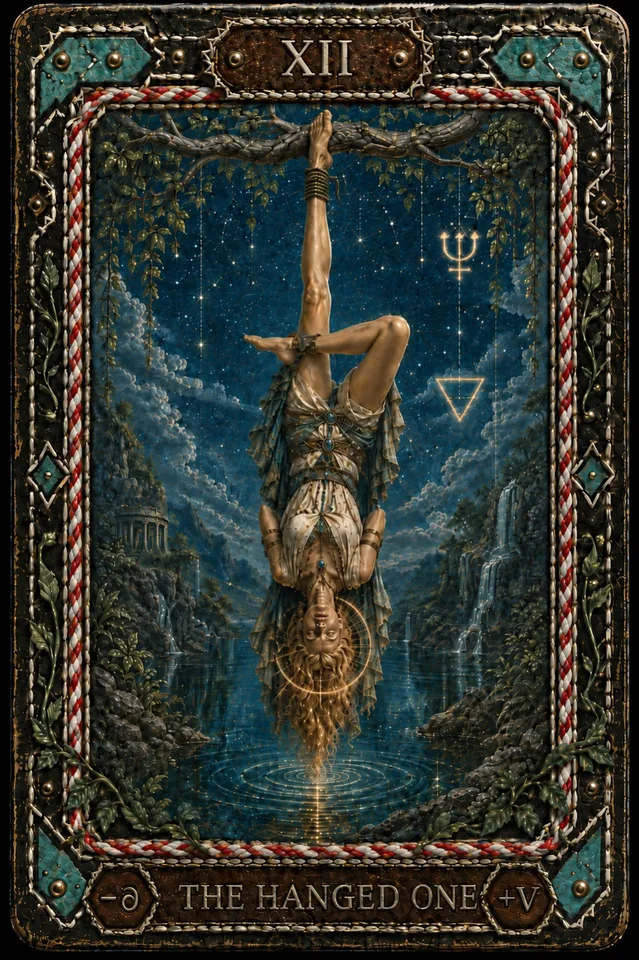
This example again shows why three levels must be kept separate: physically depicted water, the color code of the element, and the structural operation.
If all of this is simply called “Water,” the system quickly turns into associative fog.
11. One Symbol, Several Logical Levels
| Level | Question | Example |
| Physical | what properties does real water have? | faint intrinsic blue tint, dissolved substances, flow |
| Cultural | what code does a tradition use for water? | blue, white, black, a particular ornament |
| Mythological | what stories are organized around water? | birth, boundary, path, death, cleansing |
| Psychological | what domain of experience is water useful for representing? | the unconscious, state, memory |
| Structural | what relation repeats as images change? | preservation of internal content through change of form and history of path |
The central error begins when a statement from one level is presented as a statement from another.
The fact that water physically flows does not automatically yield a psychological theory.
The fact that one tradition colors Water white does not mean that white is the universal archetypal color.
The fact that Jung connects water with the unconscious does not mean that every instance of water in a dream “means the unconscious.”
But if one structural invariant consistently generates several independent functions of the symbol, the model becomes more interesting than a simple dictionary.
12. Testing with Living Cases: Does the Criterion Survive Transfer?
According to our geometry of the article, an example should not decorate a definition; it should have the right to break it. So let us test the water criterion on several cases in which there is no literal water at all.
Case 1. After Divorce, a Person Moves to Another City
The partner is gone, the apartment is different, the job is new. Yet in later relationships the person repeats the same cycle: idealization → fusion → disappointment → departure.
If we call the former partner “Water,” the model explains nothing.
If Water is the form of a state-trajectory, the object changed while the invariant remained.
Case 2. A Company Changes Leadership
New regulations are introduced within a month, but for another year employees react to mistakes as if the previous manager were still punishing every initiative.
Formal Earth has already changed.
The water-history of the state is still flowing through the old channel.
Case 3. After an Accident, a Person Drives Again
The road is physically safe, but the body enters a state of readiness for impact in advance.
The past is present not as a story about the event, but as an altered probability of the next response.
Case 4. A Family Moves
The house is different, the furniture is different, the country is different. But Sunday breakfast, the way conflicts are repaired, and the intonation of family jokes continue to assemble the same internal way of life.
The boundary changed. The content preserved its path.
Case 5. Counterexample: Translating a Message
A sentence passes from Russian into English, but the task is not to preserve the system’s internal state through time; it is to build a working connection between two separate codes.
This is closer to Air and Mercury.
The counterexample matters: not every transfer of content is Water. Water requires a history of state and continuation of an interior; Air requires a channel between regions.
13. What Makes a Definition Generative
We can now formulate the criterion more strictly.
Water is not a collection of images of rivers, seas, the Moon, and feelings. Water is an organization of experience in which internal content is preserved through a change of external form, while the next state depends on the history of the path.
Several consequences can already be derived from this formula without adding them as an independent list:
- memory matters because the previous path changes the future state;
- adaptation matters because the system changes without losing continuity;
- rhythm matters because a stable state is formed through repetition;
- loss matters because disappearance of the external carrier does not instantly erase the internal trajectory;
- phase transition matters because accumulated history eventually changes the regime itself;
- the danger of fusion matters because, with a weak boundary of its own, the interior may cease to distinguish its own from another’s.
In other words, familiar water-themes begin to be derived from the construction rather than assigned to it after consulting a dictionary.
14. But the Model Must Be Able to Lose
After Maturana, the previous articles leave us with an uncomfortable demand: a good explanation must produce new distinctions, not merely retell familiar symbols beautifully.
For the water model, this creates several possible modes of failure.
- If it cannot distinguish Water from Air in new cases, the +V coordinate does not work.
- If any kind of memory can be called Water regardless of its function, the definition is too broad.
- If all cultural meanings of water are explained only after the fact, we have produced another dictionary.
- If a new independent corpus systematically connects water-images with relations that cannot be derived from our structure, the model must be expanded.
This risk is not a weakness. The ability to lose is exactly what distinguishes a working hypothesis from symbolic immunity.
15. Why Water Changes Color — the Final Answer
The title can now be read on several levels.
Physically, water changes its observed color because of depth, illumination, and impurities, although pure water itself has a faint blue tint. [1]
Culturally, water changes color because different systems code not the object by itself, but its place within their own picture of the world.
Psychologically, water changes content because different authors use it for different domains of experience — motherhood, the unconscious, memory, transition.
Structurally, water can change external form precisely because its invariant is not located in the shape of the shell.
Water is recognizable not because it always looks the same, but because it continues to carry an interior through changes of form and preserves the history of its path.
Therefore white Water in one system and blue Water in another do not have to compete for the right to be “the real one.”
We need to ask what color is doing in each particular system.
If white marks the structural code of preserved interiority, that is one level.
If blue depicts the nocturnal surface of a lake, that is another.
If black water marks a dangerous or unknown layer, that is a third.
The archetype begins where we stop confusing these levels.
16. From Dictionary to Grammar
A dictionary of symbols is extremely useful as an archive of cultural memory. It shows which meanings have actually gathered around an image.
But grammar asks another question:
Why do precisely these meanings become possible?
Water can become an image of memory not because someone once assigned “memory” to it.
It can become an image of boundary because it separates across and connects along.
It can become an image of maternal space because it holds internal content in a medium that takes on form.
It can become an image of the unconscious because meaningful interiority can exist deeper than the immediately accessible surface.
It can become an image of transition because it exists as a trajectory rather than as a static shell.
Each of these claims can still be debated and tested. But together they already form not a list, but a generative structure.
17. The Third Step of the Series
The first article asked how the archetype turned from a form into a personality type.
The second asked what happens when a symbol outlives a tradition and loses the practice of relationship.
The third shows a more local operation: how to remove several cultural shells from one image without destroying the image and without declaring all meanings arbitrary.
What remains is a simple working question:
What changes here — and what must remain for us still to be dealing with the same structure?
This is no longer only a question about water.
The same method can be used to study the Mother, the Shadow, a tree, fire, a center, a bridge, an animal, a Tarot card, or a psychological archetype.
That is why the next article in the series will be the strictest.
It will stop asking about one symbol and try to test the entire hypothesis at once:
Can the archetypes of Jung, Pearson, Tarot, and the Zodiac be compressed into a single generative grammar without losing the distinctions for which these systems appeared in the first place?
Sources and Notes
[1] U.S. Geological Survey. “Water Color”. On the faint intrinsic blue tint of pure water and the influence of suspended matter, organics, and minerals on the color of natural water.source
[2] Working record of material from Tatiana Kobezhikova’s oral seminars — “Shamanism and the World of Spirits” (2026). This is not a published authorial text by Kobezhikova, but a summary record of material from her oral seminars; it is used here only as a source for one specific contemporary color code of the elements.
[3] V. A. Burnakov. “Water in the Traditional Worldview of the Khakas: Image and Symbol” (2019). On water as path, boundary between worlds, and maternal/ancestral image.source
[4] International Association for Analytical Psychology. C. G. Jung, Collected Works, Vol. 16: The Practice of Psychotherapy. In the summary of the Rosarium Philosophorum analysis, water is described as a symbol of the unconscious and of the movement of the life cycle.source
[5] International Association for Analytical Psychology. C. G. Jung, Collected Works, Vol. 5: Symbols of Transformation. Water appears among symbols of the maternal image and rebirth.source
[6] A. E. Waite. The Pictorial Key to the Tarot (1910), XVIII. The Moon. Description of the water in the foreground, the creature emerging from the depths, and the path between the towers as an outlet into the unknown.source
[7] The Warburg Institute. “Tarot – Origins & Afterlives”. Historical context for the transformations of Tarot and the later lives of symbolic images.source
[8] Authorial model From Metaphor to Geometry, chapter “Water”. Internal theoretical framework of the article: Water as a principle of internal state, memory, adaptation, duration, and phase transition; basic geometry −∂,+V; invariant — the form of a trajectory as objects change.
Methodological status: physical claims about water are separated from cultural and psychological interpretations. Khakas, Jungian, and Tarot materials are used as distinct corpora of symbolic experience; structural similarity between them is not presented as evidence of historical borrowing or shared external causation.