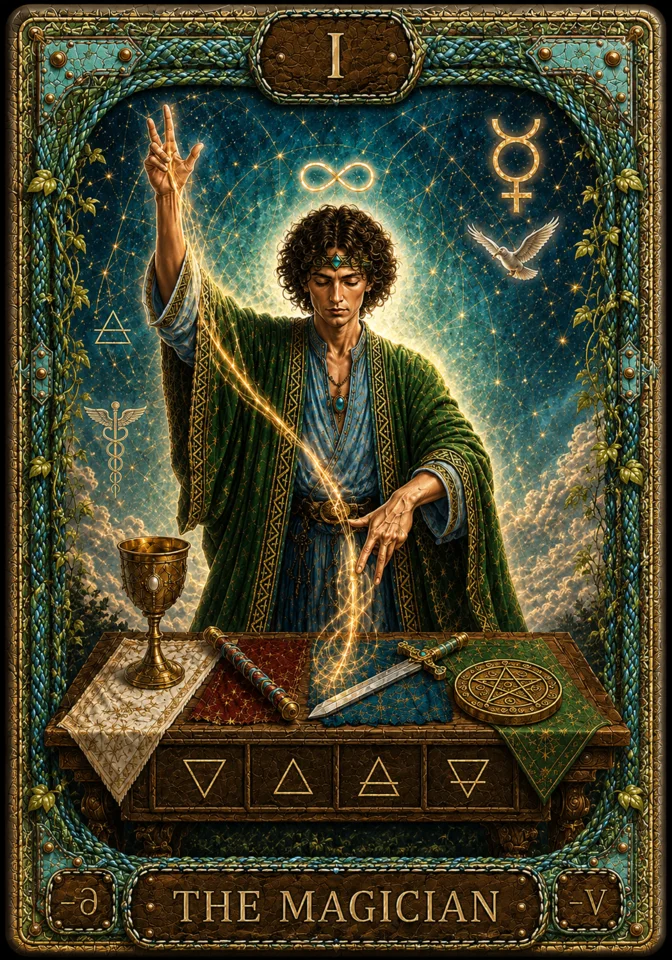
What disappears first when a tradition is broken: the image, the meaning — or the way of entering into relationship with the symbol?
A modern reader is used to asking a symbol an almost automatic question: “What does it mean?” Water means feelings. The wolf means instinct. The circle means wholeness. The Mother means care. That is how a dictionary works: there is a sign before us, and somewhere beside it there must be a meaning.
But for a living ritual tradition this question may be secondary. A symbol does not exist apart from people; it exists inside an action. Water is used to cross a boundary, to cleanse, to make an offering, to travel along a river. A spirit is addressed. A relationship is established with an animal helper. An ancestor is not merely “interpreted” — the ancestor is remembered, invoked, thanked, and one’s own place in relation to the ancestor is acknowledged.
When such an environment disappears, the image can outlive the practice. It enters a book, a museum, an occult order, a consulting room, a mass-market personality test. And each new carrier asks it a different question.
This article is not an attempt to prove a single continuous lineage from Siberian shamanism to European Tarot, or from ancient astrology to Jung. The sources do not support such a lineage. On the contrary, independent traditions are especially valuable here: they allow us to distinguish historical borrowing from structural resemblance.
The main question is different: what exactly can survive a rupture — an image, a name, a system of correspondences, a practice of relationship, or a simpler invariant that later receives another cultural shell?
Methodological note |
The section on the three spirits is based on a working record of
material drawn from Tatiana Kobezhikova’s oral seminars. It is
not a published text authored by Kobezhikova, nor an exhaustive
academic reconstruction of all Khakas beliefs, but a record of
one specific contemporary seminar presentation of a practising
tradition. Where the article discusses Khakas worldview more
broadly, separate ethnographic studies are used. Medical and
causal claims recorded in the seminar material are not evaluated
here and are not treated as medical facts. |
1. The Symbol Before the Dictionary: When Meaning Lives Inside Action
Imagine an object that has existed within a culture for a long time. As long as people know where it is kept, when it is brought out, to whom it is passed, and what is done with it, its meaning is distributed across the entire system. It lives not only in the picture, but in gesture, prohibition, route, time of day, kinship, bodily position, and place in the landscape.
This is why two outwardly identical images can perform different functions, while two dissimilar images can occupy the same place in the structure of an action. For the study of archetype this is crucial: if we look only at the shape of the picture, it is easy to mistake a cultural shell for the invariant itself.
Aby Warburg later called images capable of travelling between periods and territories Bilderfahrzeuge — “image vehicles.” The Warburg Institute explicitly uses this idea in the history of Tarot: cards carry images through time, but with each new use they enter a different system of meanings. [8]
Symbolic continuity, then, resembles not the storage of an unchanged file but the transport of cargo through many transfer points. A change of carrier almost inevitably changes the packaging. The question is: what actually arrives?
2. Khakas Material as an Independent Control Corpus
For our purposes, Khakas material matters precisely because it cannot honestly be inserted into a direct genealogy of European occultism. We are not claiming that particular Tarot cards derive from Khakas shamanism. Quite the opposite: historical independence makes the comparison stronger.
Ethnographer Venariy Burnakov shows that in the traditional Khakas worldview water could function at once as a road into other worlds and as a boundary between being and other-being; the image of land-and-water was connected with fertility, motherhood, and homeland. [2] This is no longer the dictionary equation “water = emotion,” but an entire network of relations: path, boundary, origin, transition.
Studies of sacred animals show the same complexity. The snake, for example, in the Khakas mytho-ritual complex was associated with life and death, initiation, protection, water, mountains, fertility, and the cult of ancestors. [3] One animal does not simply “mean” one thing: it occupies several places in the system.
In material drawn from Tatiana Kobezhikova’s oral seminars and fixed in a working record, this picture is supplemented by a particular system of four elements. The colour code is especially revealing: Water ranges from pale blue to transparent white, Air is blue and sky-blue, Earth is marsh-green/black, and Fire is red. [1] Even here it is clear how risky it is to search for a single “eternally correct” colour for an element.
Colour can change. A relation may prove more stable.
3. Three Spirits: Archetype Before It Became a Personality Type
The same records of the oral seminars speak of three helping spirits that accompany a person: the Spirit of the Ancestors, the Totemic Animal Spirit, and Talan, the Spirit of Fortune. Within the teaching itself these are not metaphors but spirits regarded as real within that tradition, with whom a relationship is to be maintained. [1]
For a comparative history of archetypes, however, what matters most is not whether the researcher accepts their independent existence. What matters is the structure of the relationships.
The Spirit of the Ancestors is behind me; the totemic animal is before me; the Spirit of Fortune is with me.
Before sleep, the same scheme is retained in another bodily arrangement: the ancestors are at the head, the totem at the feet, and Talan in the region of the solar plexus. [1] We are looking not merely at three characters, but at a spatial grammar.
Figure |
Position |
Underlying relationship |
Spirit of the Ancestors |
behind / at the head |
with inherited continuity |
Totemic Animal Spirit |
ahead / at the feet |
with one’s own life force |
Talan |
with me / at the body’s centre |
with emerging possibility |
3.1. The Spirit of the Ancestors: A Relationship with a Life That Began Before Me
In the source material, roots precede the name: on meeting someone, one first asks from which places and rivers the person comes, who their father and mother are, and only then what they are called. [1] This form of self-description begins not with “I am this kind of person,” but with “I am a continuation of a path that began before me.”
If we remove the literal image of a dead ancestor, a structure remains: my life does not begin at the point of my birth. Before me there already existed language, a bodily lineage, family ways of responding, the history of a place, prohibitions, skills, ways of enduring disaster, and rules of belonging.
Some of this a person knows. Some remains unknown. But what is forgotten can still organise the present. This is why the Spirit of the Ancestors can be read as a personification of continuity that survives a change of carriers.
This immediately brings us to the problem of the invariant: what survives across generations — a name, a memory, a way of responding to danger, an idea of duty, a skill, a form of care? The archetypal question here is not “what does the ancestor look like?” but “what kind of continuity makes the past active in the present?”
Why the Ancestor Is Behind One’s Back
The ancestor is not ahead. The ancestor is not the destination of the route. The figure occupies a region the person cannot directly see. This is almost a literal diagram of the action of the past: we look forward while some of the causes of our response lie behind us.
But the back is also a place of support. “My lineage stands behind me” and “my lineage decides for me” are two different geometries of the same relation. In its working form, the past supports the movement of the present. In its shadow form, it appropriates the right to determine the life of the living.
An archetypal figure, then, does not dictate a single content. It organises a relation that can be developed, damaged, and reconfigured.
3.2. Totem: A Relationship with One’s Own Life Force
In the oral-seminar material, the totemic animal is linked to lineage and natural environment rather than to a personal choice of an appealing animal. [1] The formula “totem = animal archetype” is therefore too superficial.
If we remove the specific picture — wolf, bear, bird, horse — a deeper layer appears. The totem can be read as a personification of a person’s relationship with their own life force.
Not “energy” in a vague sense, but the level of life that acts before a full rational explanation: the capacity to move, occupy space, defend oneself, sense danger, recover, withstand strain, follow a rhythm, and find a path through an environment.
Modern language might easily call this instinct. But the word “instinct” turns the process into an impersonal biological automatism. The totemic figure does the reverse: it turns life force into a relationship.
Not “I possess a certain reserve of strength,” but “I have a relationship with the degree to which my life force is fully present in my life.”
This relationship can be developed. A person can suppress force, fear it, use it without measure, lose the ability to feel it, continually spend it without noticing exhaustion, or gradually recover the capacity to rely on it.
In this sense the totem is not the life force itself. It is a personified interface between a person’s conscious map and their embodied vitality.
Why the Totem Is Ahead and at the Feet
If the ancestors answer the question “where did I come from?”, the totem answers another: “as what kind of living being do I move onward?” The feet connect the body to the ground, bear weight, and turn direction into actual movement.
Different animals provide different images of force, but the deeper scheme remains: vitality becomes visible to consciousness as an Other with whom a history of relationship is possible.
The Encounter Meditation: Not Defining a Type but Tuning a Channel
In the practice of meeting the totem, one is asked to enter a liminal state between waking and sleep, call the animal, attend to images and sensations, examine its condition, feel its strength, and establish a friendly relationship. [1]
Within the tradition, this is an encounter with a spirit. Psychological language might call it active imagination or work with an autonomous image. Both translations already alter the original ontology.
A more neutral formulation would be: the practice creates a stable channel of interaction with personified life force.
The result, then, is not the information “my totem is a wolf,” but the development of an ability to notice the condition of one’s own force, distinguish its character, recognise when the connection with it is weakening, and learn how to bring it back into action.
3.3. Talan: A Relationship with Possibility That Cannot Be Produced by Command
The third helper is Talan, the Spirit of Fortune. In the records of the oral seminars, Talan is given to a person by birthright; the connection may be disrupted, and the spirit is to be invited, fed, and honoured. [1]
If we remove the literal image, a serious structure remains. Life contains events that a person cannot produce by direct effort: one cannot command the right person to appear, accidentally open exactly the needed book, receive an unexpected offer, or discover a side door that was absent from yesterday’s map.
But one can live in such a way that an unexpected continuation is noticed, accepted, and allowed to develop.
Talan can therefore be read as a personification of one’s relationship with favourable chance and with the openness of the future.
In our geometric model this intersects with the Jupiterian function of amplifying continuations: one event can generate more subsequent events. But Talan should not simply be equated with Jupiter. The claim is one of structural resemblance, not proven historical connection.
Why Fortune Is “With Me”
Talan is neither behind the person nor ahead. Talan accompanies the process itself. This is a precise geometry of chance: a person follows a route, but at every point there are more potential continuations than the plan had allowed for.
There are two shadow forms. The first is passively waiting for possibility to do everything in one’s place. The second is recognising only outcomes that were planned in advance and therefore systematically missing lateral continuations.
The working position lies between them: I act myself, but I leave the map open enough for the world to answer with something I did not foresee.
3.4. The Three Spirits as a Single Architecture of Human Life
Together, the three figures form a remarkably compact construction:
past → life force → open future
Or, more precisely:
what supports me → what I move with → what can answer my movement
Here a person did not begin themselves, does not set themselves in motion by thought alone, and does not fully produce their own future. The three spirits turn these limits of the autonomous ego into three relationships.
4. A Strong Hypothesis: From Relationship to Personality Trait
We can now see why this material matters so much for the history of archetypes. Imagine that the three figures were placed inside a modern personality test. We would obtain an “Ancestor archetype,” an “Animal archetype,” and a “Lucky One archetype,” and the person would then be given percentages of expression.
That is exactly where the central feature would disappear.
In the original construction, the person is none of the three spirits. All three are Others in relation to the person. Distance makes relationship possible: ancestors can be forgotten and remembered; one can fear one’s life force and learn to trust it; one can fail to notice possibilities and develop greater receptivity to them.
When the archetype becomes a predicate — “I am like this” — the dynamics of the relationship collapse.
The article’s strong hypothesis |
One of the major transformations of archetypal knowledge in modern psychology may have consisted not in choosing the “wrong” archetypes, but in turning an archetypal relationship into a property of personality. |
The historical trajectory can be written like this:
spirit → inner Other → psychological function → personality type
In the ritual system there is an I and an Other. In Jung, the Other is moved inside the psyche but still retains autonomy: Shadow, Anima, and Self are not identical with the ego. In applied typology another step occurs: archetype becomes a way of describing the person — “I am a Magician,” “I am a Seeker,” “I am a Ruler.”
The language becomes more convenient. The relationship becomes poorer.
5. What Is Lost When a Tradition Breaks
When a living ritual environment disappears, the image does not necessarily disappear. Sometimes it is the best-preserved part. What is lost is the context of action: who has the right to address the figure, when, why, by what gesture, at what cost, and under what restriction.
The next carrier then begins to ask: “What does this symbol mean?” although the earlier question may have sounded different: “How does one live with it?”
A dictionary asks about meaning. Practice asks about relationship. Typology asks about belonging: “what am I?” A ritual system asks about connection: “how is my relationship organised?”
This difference allows us to look differently at the history of European symbolic systems. There too, images repeatedly outlived their original context and received new explanations.
6. Tarot: First the Image Outlived Its Original Function
Tarot is particularly useful for this history because its “afterlives” are well documented. The Warburg Institute traces the cards from a fifteenth-century Renaissance card game to an instrument of divination, artistic work, mystical system, and contemporary reflection. [4]
This dismantles two overly simple stories.
First: that the Major Arcana were from the outset an ancient psychological or esoteric system.
Second: that later occultism simply corrupted the original cards.
Something more interesting happened: a corpus of images outlived its early function and proved capable of supporting new systems.
Etteilla: One of the Decisive Ruptures
In the eighteenth century Jean-Baptiste Alliette, known as Etteilla, played an important role in turning Tarot into a specifically divinatory and occult system. The Warburg Institute highlights his deck as the first known Tarot deck designed explicitly for divination and linked to the idea of ancient Egyptian wisdom. [5]
What matters here is not whether that Egyptian genealogy was historically correct. What matters is that after this shift the deck begins to live in a different ontology. From a game it becomes a carrier of hidden knowledge.
Éliphas Lévi: The Symbol Enters a Larger Architecture
In the nineteenth century Éliphas Lévi became one of the central figures in the occult reinterpretation of Tarot; contemporary historians specifically examine his influence on later occult readings of the cards. [6]
A significant change of logic occurs here. A card no longer merely predicts an event. It occupies a place in a system linking Kabbalah, magic, numbers, letters, religious correspondences, and astrological correspondences.
The symbol begins to function as a node in a network.
7. Golden Dawn: The Occultist as Systems Engineer
By the end of the nineteenth century the Hermetic Order of the Golden Dawn takes the next step. Its legacy is interesting not because we are obliged to accept every correspondence as true, but because of the architecture of the task itself.
The Order attempts to connect Tarot, Kabbalah, astrology, alchemical symbols, letters, numbers, colours, and ritual grades. A vast diversity of symbols is generated through a limited set of interrelated coordinates.
Structurally, this is no longer a catalogue. It is an attempt to build a generative grammar.
The grounds for particular correspondences can be criticised. But it is not honest to describe such a system as lacking intellectual structure simply because it belongs to occultism.
Waite and Pamela Colman Smith: The Card Becomes an Interface
Arthur Edward Waite and Pamela Colman Smith were associated with the Golden Dawn; the deck they created was first published by William Rider & Sons in 1909 and became one of the standard forms of modern Tarot. The British Museum confirms this history. [7]
Their most important contribution for our purposes is visual. Meaning becomes a scene.
Previously, meaning could be stored in a table of correspondences. Now the space of the card itself begins to work: pose, direction, distance, boundary, object, action, background.
In this sense, Rider–Waite–Smith is not merely a set of illustrations but an interface for a theory.
This is why a card can survive even the forgetting of its original commentary: part of the relational structure remains visible.
8. Astrology: Another Kind of Continuity
Tarot preserves above all a corpus of images. Astrology works differently: much of its persistence is secured by relations and rules of composition.
Signs, planets, elements, modalities, and aspects may be interpreted differently in different periods, but the grammar of relations can survive a change in philosophical explanation.
An ancient astrologer, a Renaissance magician, and a twentieth-century psychological astrologer may give very different answers to the question of why a birth chart means anything at all. Yet part of the formal apparatus remains recognisable.
This is an important contrast: Tarot shows the migration of images especially well, while astrology shows the migration of combinatorial structure.
For this reason astrology, when studying archetypes, should not be reduced to another list of “personality types.” Its strength lies precisely in the fact that a concrete configuration is built from several levels instead of being presented as an independent entity.
9. The Urban Occultist: Custodian or Reconstructor?
Here it is easy to fall into two symmetrical extremes.
One romanticises the occultist as the final custodian of an unchanged ancient wisdom.
The other portrays the occultist as a superstitious collector of disconnected symbols.
Historically, it is more productive to see the occultist as translator and reconstructor. Nineteenth-century European occultism developed within a culture of print, comparative religion, archaeology, Orientalism, museums, and new scientific classifications. Older images entered an environment in which they began to be compared systematically.
Here it is especially important to distinguish historical continuity from structural reconstruction. A new table of correspondences may be intellectually strong and yet not ancient.
The same applies to colours. A modern European viewer almost automatically paints water blue. In the material from Kobezhikova’s oral seminars, Water can shade into transparent white, while Air is given blue/sky-blue. [1] The contrast itself shows that a colour code belongs to a cultural shell and need not coincide with the deeper structure of the element.
We currently have no basis for claiming that a particular colour in Waite arose from school geography or cartographic convention. But the question of a new visual environment remains legitimate: when an image enters an atlas, a printed deck, or a museum, it begins to live according to the rules of a new carrier.
10. Academic Psychology Was Born Beside Occultism, Not After It
A convenient retrospective picture draws a wall: science on one side, spiritualism, mediumship, and occultism on the other. The history of early psychology shows a much more permeable boundary.
Historian Andreas Sommer has shown that psychical research was connected with the formation of American psychology, and that William James understood himself both as a psychologist and as an investigator of mediumship, telepathy, and other contested phenomena. [9]
Carl Gustav Jung enters this history even more visibly. His 1902 medical dissertation, “On the Psychology and Pathology of So-Called Occult Phenomena,” grew out of séances with his cousin Hélène Preiswerk; later scholarship shows how he subsequently reworked this material in increasingly psychological terms. [10]
Psychological science, then, did not simply discover a ready-made category called “occultism” outside its territory. It formed its own boundary beside material that it was itself partly investigating.
Historian of Western esotericism Wouter J. Hanegraaff describes a broader process: whole intellectual traditions gradually became “rejected knowledge” against which academic culture defined its own identity. [11]
This does not mean that academic and esoteric knowledge are equally valid. It means that the name of a camp cannot substitute for analysing the structure of an explanation.
11. Jung: The Great Relocation of the Address
Jung’s central move can be described as a change of address.
For a shamanic tradition, a spirit can be an Other existing in the person’s world of relations.
For an occultist, a symbol may express an objective structure of the cosmos.
Jung increasingly asks a different question: why do similar figures and plots recur in psychic life?
For Jung, an archetype is not the same as a ready-made picture. The International Association for Analytical Psychology summarises the Jungian view of archetypes as pre-existing forms that shape psychic material and manifest through concrete images. [12]
This is an extremely important translation: an image no longer has to establish its external ontology in advance in order to become psychologically significant.
A demon can be studied as a psychic image. An alchemical transformation can be studied as a model of an inner process. A mandala can be studied as a form for organising a whole.
But the very act of translation changes the status of the figure.
The Other of the world becomes the Other of the psyche.
Here the strong hypothesis drawn from the three spirits gains a historical axis: spirit → inner Other → psychological function → personality type.
12. Jung Did Not Close the Door on Tarot or Astrology
It is important not to create a second false history — as if, once the symbol was psychologised, Tarot and astrology disappeared from the Jungian environment.
In Jung and Tarot: An Archetypal Journey, Sallie Nichols read the Major Arcana as an archetypal journey; the publisher notes that she taught Tarot symbolism to students at a C. G. Jung Institute. [13]
Psychological astrology developed even more systematically. The Centre for Psychological Astrology, founded by Liz Greene and Howard Sasportas in 1983, explicitly set out to cross-fertilise astrology with depth, humanistic, and transpersonal psychology. [14]
The question “why did psychologists ignore Tarot and astrology?” is therefore too crude.
A more precise question is: why did these hybrid traditions remain at the periphery of institutional psychology while mass-market archetypal psychology created new, more convenient lists of characters?
To answer that, we have to move from ideas to institutions.
13. The Cancer–Capricorn Axis of History: Who Preserves Knowledge, and Who Has the Right to Interpret It?
A tradition does not exist only in a head. It always has a container.
A shamanic community transmits knowledge through kinship, ritual, bodily practice, initiation, place, and prohibition.
An occult order transmits it through grades, texts, tables, ritual roles, and restricted access.
A book makes knowledge portable without a personal carrier.
A psychoanalytic institute moves the symbol into a practice of interpreting the individual psyche.
A university requires sources, method, and public criticism.
Popular psychology asks for something almost opposite: clarity, speed, and the possibility of using a system without years of initiation.
Each container strengthens one thing and weakens another.
Oral practice preserves relationship well but survives the death of carriers less reliably.
A book preserves text extremely well but separates it from the situation of use.
A university strengthens source criticism but may exclude experience that is difficult to operationalise.
A mass-market test makes the system accessible but easily turns relationship into a personality trait.
A rupture in tradition is therefore not merely a loss of information. It is a change in the architecture of transmission.
14. What Counts as Knowledge: Maturana’s Simple Test
In the first article of this series we already encountered the danger of automatically treating a psychological explanation as more scientific simply because it was produced by a psychologist. Here the question returns from another direction.
Humberto Maturana proposed a criterion of scientific explanation that is very simple in spirit. It can be restated as four questions. [15]
What exactly are we observing, and what must another observer do in order to observe the same phenomenon?
What mechanism, according to our hypothesis, generates this phenomenon?
What else should follow from the proposed mechanism, beyond the case we already know?
Do we actually observe that additional consequence under the conditions where we said in advance it should appear?
At this level, the words “psychologist,” “astrologer,” and “occultist” really are not enough.
A system can be very beautiful and complex, but if it explains only the material from which it was built, it remains an interpretation.
On the other hand, a symbolic or ritual phenomenon does not cease to be researchable merely because it is subjective or culturally specific. We simply have to state honestly what is being tested: external causation, the structure of experience, the effect of a practice, or the transferability of a model.
Key distinction |
The historical and symbolic interest of a system is not the same as evidence for its causal claims. Tarot can be a strong corpus of images, astrology a strong combinatorial grammar, and shamanic practice a strong technology of relationship. The scientific status of each specific claim still requires its own procedure of testing. |
15. What Survives the Rupture?
We can now return to the original question.
What survives the transition from shamanic ritual to occult table, Tarot card, psychological concept, and popular test?
Not necessarily colour.
Not necessarily a name.
Not necessarily a particular god.
Not necessarily an explanation of causation.
Sometimes a simpler relation proves more stable:
a path between regions;
a boundary between states;
a centre around which a multiplicity is organised;
a container that holds content;
a link between present and past;
a relation of consciousness to life force;
openness to a continuation that was not planned;
a threshold beyond which the previous route no longer reproduces itself.
Such relations can survive a change of cultural shell more easily because they do not require the same picture to be preserved.
This is where the working idea of an archetypal invariant emerges.
16. Image as Vehicle, Invariant as Cargo
Warburg’s Bilderfahrzeug gives us a useful metaphor. The image is a vehicle of culture. [8]
But vehicle and cargo are not the same thing.
One image can carry different explanations. The same structural invariant can change vehicles and take on another image.
For example, a relationship with life force may be personified as a totemic animal, described as an instinctive function, represented by a mythological helper, or expressed through bodily practice. These forms should not automatically be declared identical. But we can ask whether they preserve the same structure of relationship.
That question is stronger than a hunt for the “oldest correct meaning.”
It allows both continuity and genuine novelty.
17. Three Questions That Change After This History
After this journey, the three shamanic figures can no longer be returned to the form of simple labels.
Not “What is my ancestral archetype?” but: what from the past continues to support my present — and what continues to speak in my voice even though it no longer belongs to my life?
Not “What does my totem mean?” but: what is my relationship with my own life force, and can that relationship be developed?
Not “How do I attract luck?” but: how capable is my map of the future of noticing and accepting a continuation that I did not plan myself?
And this may be the most important lesson a living tradition offers to the history of archetypes.
We are accustomed to preserving nouns: Ancestor. Wolf. Fortune. Magician. Mother. Shadow.
But when a tradition breaks, verbs may disappear first: remember, address, sustain, trust, translate, test, reconfigure a relationship.
If so, the task of the history of archetypes is not only to restore the correct meanings of old symbols.
We also have to try to recover the type of action and relationship that a symbol once made it possible to hold.
18. Conclusion: A Symbol Can Outlive Its Own Explanation
The history is more complicated than the elegant scheme “ancient wisdom → forgetting → restoration.”
What we see instead is a succession of different containers:
lived world → ritual practice → image → occult reconstruction → psychological translation → applied typology
Each transition preserves something, strengthens something, and loses something.
Shamanic practice preserves relationship especially well.
Tarot preserves the image.
Astrology preserves a combinatorial grammar.
An occult order preserves a network of correspondences.
Jung preserves the distinction between image and form.
Academic culture preserves procedures of criticism and testing.
Popular psychology preserves an accessible human language.
None of these carriers is complete.
That is why the central protagonist of this history is not a particular symbol, not Jung, and not Waite.
It is the invariant.
What can survive a change of ritual, image, institution, and explanation — and still remain a recognisable structure?
The next article in the series will take one of the simplest and oldest images — water — and use it to test this hypothesis in practice.
Why can water be blue, white, black, golden, maternal, dangerous, cleansing, liminal — and still not become an arbitrary bag of associations?
If we really can distinguish a cultural shell from a generative structure, it should become visible in a single concrete symbol.
That is where we will continue.
Sources and Notes
The sources used for the historical and comparative sections are listed below. A working record compiled from Tatiana Kobezhikova’s oral seminars is used as a source for one specific contemporary presentation of practice; its claims are not automatically generalised to the whole of Khakas tradition.
[1] Working record of material from Tatiana Kobezhikova’s oral seminars, “Shamanism and the World of Spirits” (2026). This is not a published work authored by Kobezhikova, but a summary record compiled from her oral seminars; the article uses the sections on the three helping spirits, totemic practice, and the system of elements.
[2] V. A. Burnakov. “Water in the Traditional Worldview of the Khakas: Image and Symbol”. Ethnographic study of water as path, boundary, and maternal/ancestral symbol. — source
[3] V. A. Burnakov. “Remnants of the Snake Cult Among the Khakas (Late 19th to Mid-20th Century)”. On the sacred animal, protective function, initiation, connections with water and mountains, fertility, and ancestor cult. — source
[4] The Warburg Institute. “Tarot – Origins & Afterlives”. A history of Tarot from a Renaissance card game to later artistic and mystical transformations. — source
[5] The Warburg Institute. Conversation with Bill Sherman on “Tarot – Origins & Afterlives”. On Etteilla’s role in the transition to divinatory and occult Tarot. — source
[6] The Warburg Institute. Peter Forshaw, “Eliphas Levi and the Occult Tarot”. On Éliphas Lévi and the formation of nineteenth-century occult Tarot. — source
[7] The British Museum. Arthur Edward Waite. Biographical note: Waite, the Golden Dawn, Pamela Colman Smith, and the 1909 deck. — source
[8] The Warburg Institute. Bilderfahrzeuge Research Group. On Aby Warburg’s concept of Bilderfahrzeuge — “image vehicles” — and the migration of images. — source
[9] Andreas Sommer. “Psychical research and the origins of American psychology” (2012). On the relationship between psychical research and the formation of American psychology, including William James. — source
[10] Sonu Shamdasani. “‘S. W.’ and C. G. Jung: mediumship, psychiatry and serial exemplarity” (2015). On the séances with Hélène Preiswerk and Jung’s 1902 dissertation. — source
[11] Wouter J. Hanegraaff. “Esotericism and the Academy: Rejected Knowledge in Western Culture” (Cambridge University Press, 2012). On the formation of Western esotericism as “rejected knowledge” in the history of academic culture. — source
[12] International Association for Analytical Psychology. “Volume 9.1: The Archetypes of the Collective Unconscious”. Summary of Jung’s understanding of archetypes as forms manifesting through concrete psychic material. — source
[13] Sallie Nichols. “Jung and Tarot: An Archetypal Journey”. Publisher information and details on teaching Tarot symbolism in a Jungian setting. — source
[14] The Centre for Psychological Astrology. History. On the founding of the CPA by Liz Greene and Howard Sasportas and the cross-fertilisation of astrology with depth, humanistic, and transpersonal psychology. — source
[15] Humberto R. Maturana. “Reality: The Search for Objectivity or the Quest for a Compelling Argument” (1988); “Science and Daily Life” (1990). Four operational conditions for validating a scientific explanation. — source
Text status: a historical-conceptual article with comparative and methodological layers. Ontological claims made by religious and occult traditions are presented as positions within those systems; the article does not present them as established physical causation.