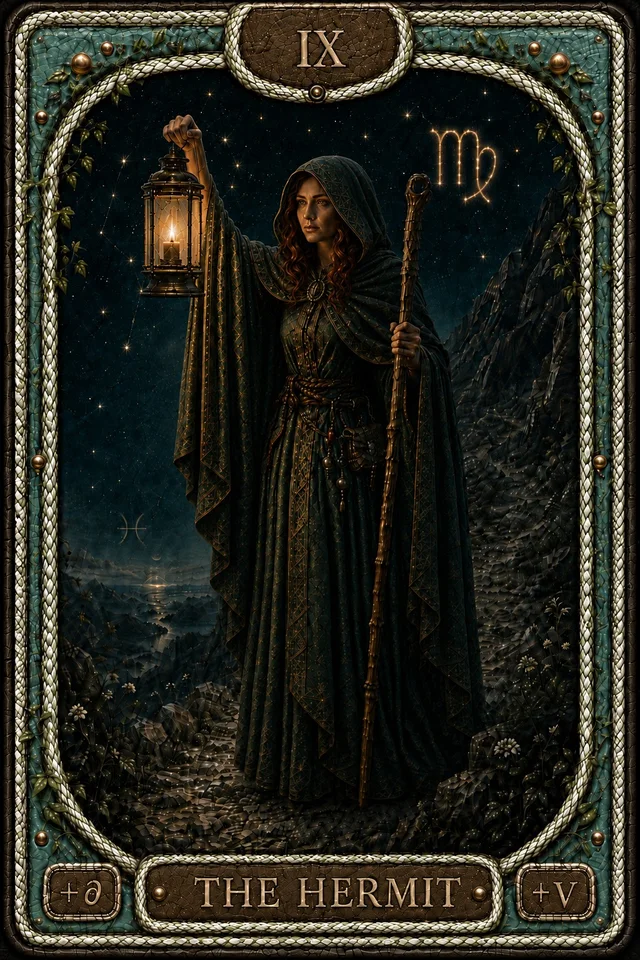
An archetype is easy to recognize in a picture. It is much harder to understand what remains when the picture is removed.
The first article in the series From Image to Geometry
Introduction. Remove the Labels from the Doors
Imagine Europe around the year 1900. Several people are sitting at one table—people whom later history will place on very different shelves of the library.
The first casts a horoscope. He believes that a limited number of planets, signs, elements, and relations among them can describe an enormous variety of human situations. The second belongs to an occult order and works with Tarot, Kabbalah, alchemical symbols, letters, numbers, and color scales as parts of a single system of correspondences. The third calls himself a psychologist and studies perception, hypnosis, automatic writing, and unusual states of consciousness. The fourth is the young Carl Gustav Jung: his medical dissertation grew out of observations of mediumistic séances, and later he would increasingly translate such material from the language of spirits and mediumship into the language of the psyche [1].
A century later, we distribute labels with ease. The astrologer is an esotericist. The member of the Golden Dawn is an occultist. Jung is a psychologist. William James is a classic of science. Yet a label mainly tells us which institutional box now stores a name. It says nothing yet about the structure of the explanation itself.
If we erase the words “psychologist” and “esotericist,” a harder question remains: who among them built the more rigorous model—and in what sense, exactly?
This article does not try to prove that occultism was “real science unfairly suppressed,” nor does it defend the opposite legend—that psychology replaced chaotic superstition and was the first to learn how to treat symbols rationally. Both stories are too convenient. The historical picture is more interesting: several traditions addressed neighboring problems by different means, exchanged material, argued about the status of explanations, and gradually drew boundaries that now seem natural.
What matters to us is not the prestige of a name but the architecture of a model. How many independent entities does it introduce? Are there rules from which new cases can be derived? Can description be distinguished from explanation? What counts as a test? And above all: what happened to the very idea of the archetype—from Jung’s “form” to modern tests in which a person receives a Seeker, Ruler, or Magician profile?
1. The Problem of the Archetype Existed Before Jung
Jung was not the first to notice recurring symbolic forms. His historical novelty lay rather in making that recurrence a specifically psychological problem.
Long before analytical psychology, astrology already offered a kind of combinatorial grammar. It does not create a separate independent description for every person. It takes a limited set of elements—planets, signs, elements, modalities, relations—and produces many configurations from their combinations. One may reject astrological causation and still acknowledge an architectural fact: this is an attempt to explain diversity by combination rather than by an endless catalogue of types.
That distinction is especially important here. A system that says “the Warrior exists because people sometimes behave like warriors; the Seeker exists because people sometimes seek” classifies phenomena already observed. An astrological construction asks a different question: from what elements and relations is a particular configuration composed? Its internal logic may be disputable, but the kind of problem it poses is already generative.
Astrology is therefore relevant here not as a set of predictions and not as an established physical theory of celestial influence. It matters as an historically early attempt to build a small language capable of generating a large number of human distinctions.
Not “Older Means Truer”
The age of a system proves nothing. Traditional astrology, moreover, is itself extremely expensive in the number of assumptions it can require: signs, planets, houses, aspects, dignities, rulers, orbs, house systems, and different rules of combination. If every correspondence must be accepted separately simply because “tradition says so,” we do not have Occam’s razor; we have an enormous table.
The question, then, is not “which is older, Pearson or the Zodiac?” but “which system can explain more observations with fewer independent rules—and which of those rules are actually testable?”
2. Nineteenth-Century Occultism: Not Only Belief, but an Engineering of Correspondences
The history of Tarot makes the point even more clearly. The cards emerged in Renaissance Italy as part of card-playing culture, while their transformation into an esoteric system was a later reconstruction. The Warburg Institute now presents Tarot history as a sequence of major transformations: from courtly game to divination, and then to artistic, mystical, and political media [2].
This matters for two reasons. First, we cannot claim without evidence that the Major Arcana reached us unchanged as an ancient psychological treatise. Second, a later reconstruction need not be intellectually empty merely because its own legend of origin was inaccurate.
By the end of the nineteenth century, the Hermetic Order of the Golden Dawn had undertaken an extraordinarily ambitious project: to connect Tarot, astrology, Kabbalah, alchemy, elements, letters, numbers, ritual grades, and color systems within a single network of correspondences. Such a network may contain forced links and historically debatable connections, but in form it resembles a project of formalization: many images are to be generated or organized through a limited set of coordinates.
Lévi, the Golden Dawn, Waite: Different Ways of Assembling a Symbolic World
Éliphas Lévi, MacGregor Mathers, Arthur Edward Waite, Aleister Crowley, and other authors of the occult revival did not primarily argue about whether symbolic connections existed at all; they argued about how those connections should be organized. Contemporary scholarship on Tarot history increasingly treats these reconstructions as intellectual material in their own right rather than merely as curiosities [3].
Waite is especially important for our purposes. The British Museum describes him as an occultist and Rosicrucian and notes his collaboration with Pamela Colman Smith on the deck first published in 1909; both were connected with the Hermetic Order of the Golden Dawn [4].
3. Waite and Pamela Colman Smith: When a Table Becomes a Scene
The Rider–Waite–Smith deck matters here not because it is “the most correct” deck, but because it demonstrates a transition from vocabulary to space. Smith turned many abstract pip cards into scenes in which meaning was stored not only in a caption but in composition: who is connected to whom, where a gaze is directed, what is separated, what is enclosed, and where a path runs.
Take the Magician. One can say: “Mercury means communication, dexterity, mediation.” That is a dictionary. Or one can depict a figure between above and below, with different implements arranged before him and a gesture linking separated levels. Then meaning becomes a relation inside a scene. We still have not proved that this relation is the card’s “true meaning,” but we have obtained a much more interesting object of study.
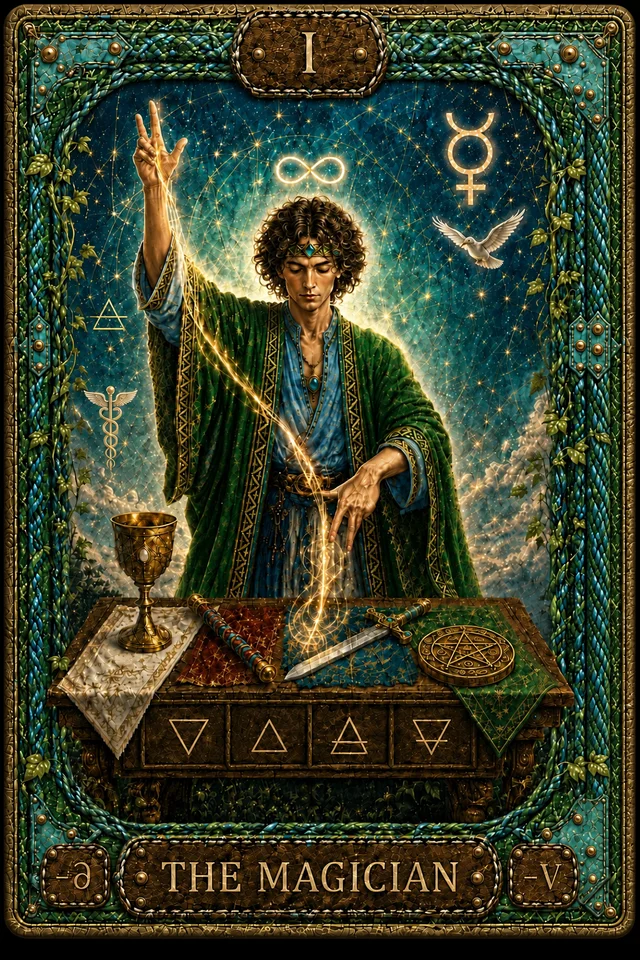
Here occultists display a strength that later popular psychology often loses: they try not merely to name a figure but to embed it in a system of relations. The weakness appears when correspondences are assigned faster than any independent method emerges for testing whether they generate anything beyond an elegant coincidence.
4. Science and Occultism Had Not Yet Moved into Separate Buildings
It is easy today to imagine a neat sequence: superstition—occultism—psychology—scientific psychology. The reality around the turn of the twentieth century was far less tidy.
William James played a central role in the formation of American psychology and in Harvard’s intellectual life, while also taking psychical research seriously. Harvard itself preserves institutional traces of this line, including collections connected with psychical research [5].
Jung, too, began at the border. His early study of mediumistic phenomena was later reinterpreted in psychological terms, but it shows that “occult” and “psychological” were not originally two hermetically sealed domains [1].
This permeability should not be romanticized. The fact that a scientist studies a medium does not confirm a mediumistic theory. But it does undermine the comfortable retrospective story that academic psychology knew from its first day exactly where the final boundary of admissible phenomena lay.
The history of a discipline is also a history of institutional selection: which questions are admitted, which methods are considered sufficient, what acquires the status of an object of research, and what is pushed beyond the professional field. The border between “science” and “the occult” was not discovered once as a ready-made line on a map; it was repeatedly drawn and redrawn.
5. What Jung Actually Did
Once Jung is no longer made the beginning of the entire history of symbolic thought, his contribution becomes not smaller but more precise. He shifted the address of explanation.
A ritual or occult tradition may say: a certain force or correspondence exists in the structure of the world. Jung allows a different question: why does the human psyche repeatedly produce these forms of experience and image?
A demon need not first become an object of physics in order to be psychologically significant. An alchemical sequence can be studied as a map of psychic transformation even if alchemical chemistry is rejected. A mandala can be investigated as a form that organizes experience. The ontological claim has changed, but the symbolic material remains available for inquiry.
Jung himself took astrology seriously. In his work on synchronicity, he turned to the horoscopes of married couples. The material did not yield a straightforward statistical confirmation of astrological expectations; instead, it became part of a more complex argument about synchronicity. This matters precisely because Jung did not simply place astrology outside the walls of psychology.
Archetype Is Not the Same as Archetypal Image
Jung’s decisive distinction for our purposes is that an archetype cannot be reduced to a particular picture. The International Association for Analytical Psychology, in summarizing the relevant sections of Jung’s Collected Works, describes the archetype as a predisposed form or possibility of representation rather than as a fixed inherited image [6].
If the Mother can appear as an actual mother, a goddess, the sea, the earth, a cave, or a garden, then a woman with a child is not yet a definition of the archetype. We must identify what survives the change of images.
In that sense, Jung formulated an exceptionally strong problem and left it partly open: if an archetype is a form, what logical kind of form is it?
6. Eight Jungian Figures Without Their Costumes
Popular psychology likes to line archetypes up as if they were characters of the same order. Yet once the images are removed, Jung’s figures begin to behave very differently.
The Mother: Not a Character, but a Holding Environment
Remove one’s own mother, Demeter, the Madonna, the cave, the sea, and the garden. What remains is a structure of origin, nourishment, and holding. It creates an inside, grows and protects what is within, and can at the same time absorb it or prevent separation. This looks less like a personality type than like an environment or a configuration of boundary, content, and nourishment.
The Child: Not a Character, but a Still-Fragile Future
Remove the infant and the miraculous child, and what remains is something already present but still small relative to the old world; at the same time, it carries a field of future continuations that the present system cannot yet realize. This is closer to a phase of transition than to a trait.
The Trickster: A Remainder the System Declared Overcome
Jung’s Trickster is connected with earlier, less differentiated levels and with counter-tendencies. Beneath the masks of rogue, animal, demon, or clown we can see the return of something the developed system imagines it has already left behind. The Trickster may therefore be less an independent “type” than a dynamic remainder of an excluded or insufficiently differentiated regime.
Kore: A Useful Negative Result
Kore matters precisely because she resists becoming an independent atom. In Jung, the same feminine figure may perform different functions depending on the psychic relation in which it appears. This suggests that some things called archetypes may in fact be roles within a larger structure rather than fundamental structures in their own right.
Spirit / Wise Old Man: The Function of Missing Knowledge
Remove the beard, staff, magician, and mentor. What remains is a compensatory function: when the conscious way of solving a problem is exhausted, an additional source of distinction, advice, or knowledge appears. This already looks like an operator rather than an environment.
The Shadow: The Relation Between a Map and What It Excludes
The Shadow fits poorly into any typology of people. It appears when the operative self-image excludes part of experience, while the excluded material continues to act—through irritation, projection, fantasy, or repetition. Here the resemblance to the model used in this book is especially close: the Shadow is defined there as the incompleteness of the operative map of experience.
Anima / Animus: Interface and Projection
If we temporarily remove the historical gendered shell, what comes into view is the relation between a conscious position and a psychic Other. The figure acts as a mediator between domains and is especially prone to projection. In structural language, this is closer to an interface or a relation than to a character type.
The Self: The Geometry of Center and Whole
The Self is expressed through mandala, circle, quaternity, centering, and the unification of opposites within a wider whole. Here the character nearly disappears. We are dealing with an organization of space: center, boundary, symmetry, inclusion, relation among parts, and a larger order in which the ego is no longer the only center.
Mother—environment. Child—phase. Shadow—relation. Spirit—function. Anima/Animus—interface. Self—organization of the whole. Why are we sure that all of these are entities on the same logical level simply because one word—“archetype”—is used for them?
A contemporary IAAP research report on archetype theory likewise emphasizes the internal heterogeneity of Jung’s concept and the need to rethink it [7]. This is not a reason to “cancel” Jung. On the contrary, it allows us to take his initial question more seriously than the later vocabulary sometimes does.
7. After Jung: Each Author Chose a Different Scale
After Jung, archetypal thought did not develop as one unified theory. Different authors extracted different problems from it.
Author / line |
What they did |
What the archetype becomes |
Erich Neumann |
archetypal stages in the development of consciousness |
archetype as a phase of a larger process |
Marie-Louise von Franz |
fairy tales and recurring motifs |
archetype as a structure of plot and image |
Joseph Campbell |
comparative mythology and the hero’s journey |
archetype as a recurring large-scale narrative |
James Hillman |
archetypal / imaginal psychology |
archetype as a plurality of images and perspectives |
Tom Chetwynd |
dictionaries of dreams and symbols |
archetypal material as a navigational corpus of meanings |
Jean Shinoda Bolen |
Greek goddesses as psychological patterns |
archetype moves closer to a recognizable type of person |
Moore and Gillette |
King, Warrior, Magician, Lover |
archetype as a major character and polarities of maturity / shadow |
Carol Pearson |
12 archetypes for development and self-observation |
archetype as an applied profile and life narrative |
Tom Chetwynd occupies an intermediate position here. His securely attributable works are above all dictionaries of dreams, symbols, and sacred myth. He systematizes recurring images and possible readings. This is not yet a typology of personality. It is closer to a corpus of material: where does a symbol recur, what meanings gather around it, and how may the reader navigate among them?
8. How Form Became a Character, and the Character Became a Profile
The movement from Jung to Pearson cannot be described simply as “simplification.” It was functional. It is easier for a person to recognize the Seeker, Caregiver, or Ruler than a “dynamic structure of relation between conscious and unconscious contents.”
A character gives a face, motivation, fear, action, and plot. For self-description, education, coaching, and consultation, that is a major advantage. Pearson’s system was deliberately developed as an accessible model of human development, drawing on Jung, Hillman, Campbell, Erikson, and related traditions [8].
But convenience changes the logical type of the object. A formative principle becomes a recognizable character. The character becomes a bundle of motivations. The bundle of motivations becomes a psychometric profile. The same word—archetype—continues to travel, but it no longer necessarily names the same kind of thing.
Form → image → character → personality type. The history of the word remains continuous while the object under the word changes.
9. Why Did Psychologists Create New Archetypes If Tarot and the Zodiac Already Existed?
The most tempting answer is that psychology arrogantly ignored ready-made systems and then reinvented the same thing. Institutional boundary-making did play a role, but that explanation is not sufficient.
First, astrology and Tarot were not ready-made psychological theories in the modern sense. To use them as psychological models, one first had to decide what counted as the psychological object and what epistemic status should be assigned to astrological and occult claims.
Second, later psychological typologies solved different engineering problems: they offered accessible languages for motivation, development, branding, leadership, or therapy. Names such as “Seeker” and “Caregiver” work faster than a lecture on planets, signs, and houses.
Third, Tarot and astrology were not forgotten. Jung worked with astrological material; later, psychological astrology emerged. Sallie Nichols explicitly linked the Major Arcana to a Jungian journey. So the issue was not blindness but the fact that hybrid lines remained peripheral to mainstream academic psychology.
The better question is therefore not “why did they fail to notice?” but “why did the same symbolic material acquire different epistemic status in different institutions?”
10. Remove the Names of the Disciplines: What Counts as a Scientific Explanation at All?
Here it helps to invite judges who belong to neither Jungian psychology nor the occult tradition: Humberto Maturana and Francisco Varela. In The Tree of Knowledge they invite us to think of knowing not as a simple copy of a ready-made external world, but as an activity of a living observer. In a later and especially clear formulation, Maturana unfolds the criterion for a scientific explanation into four operational steps [9].
In plain language, a scientific explanation should be able to do four things:
Show exactly what we are observing. Not “the energy went bad,” but a procedure and a distinguishable phenomenon that another observer can also obtain.
Propose a mechanism that generates the phenomenon. Not merely rename what was observed, but explain how it comes about.
Derive something else from the mechanism—something that was not simply built into the original description. A good model has to take a risk: it must tell us a new result.
Check whether that new result actually occurs under the conditions specified in advance.
In this logic, the word “psychology” does not give a theory an automatic pass into science. Nor does the word “esotericism” automatically refute it. The question is not the sign on the door but what the theory does when asked to pass through those four steps.
Description recognizes what has already been seen. Explanation provides a mechanism from which a result follows that was not used to build the model.
Why This Matters Especially for Archetypes
Archetypal systems easily close into a hermeneutic loop. We see a behavior, call it a manifestation of an archetype, and then confirm the existence of the archetype by observing similar behavior. Such a circle may be therapeutically or culturally useful, but by itself it is not yet a generative explanation.
11. A Label-Free Test: Four Systems Before One Criterion
System |
Phenomenon defined? |
Generative mechanism? |
New consequences? |
Independent test? |
Pearson archetype typology |
partly |
mostly classificatory |
limited |
depends on the specific version of the instrument |
Jungian archetypal theory |
partly |
rich conceptual model; weaker operational criteria |
many hermeneutic consequences |
ambiguous |
Developed astrological system |
formally, often yes |
strong compositional grammar |
potentially many |
the main disputed point |
Golden Dawn / systematic Tarot |
yes, within the system |
strong network of correspondences |
yes, within the model |
weak external validation |
Experimental psychology |
usually yes |
ranges from weak to strong |
usually required |
methodologically built in |
Our geometric model |
aims to |
generativity is its claimed strength |
must produce them |
still to be demonstrated |
This table deliberately awards no medals. It displays different weaknesses. A popular typology may be more humanly accessible but weaker as a generative theory. Astrology may possess a richer compositional architecture but fail at independent validation. Experimental psychology is methodologically stronger in procedures of testing, but that does not mean every psychological theory automatically inherits the same evidential status.
So Which Is Closer to Science?
If we compare modern experimental psychology as a whole with arbitrary divinatory interpretation, the answer plainly leans toward the former: operationalization, control, statistics, replication, and criticism are institutionally embedded there. But that is too broad a comparison to be very interesting.
If, instead, we compare Jungian archetypal theory or Pearson’s typology with a developed astrological or occult system of correspondences, the automatic advantage disappears. Astrology and the Golden Dawn sometimes display stronger generative architecture; academic psychology has a stronger culture of external testing. Neither strength automatically compensates for the absence of the other.
That is why “this is psychology” is insufficient as an argument for scientific status, just as “this is an ancient tradition” is insufficient as an argument for truth.
12. Occam’s Razor: Not Old Versus New, but Catalogue Versus Grammar
We can now ask whether psychology has “multiplied entities” without turning the question into rhetoric.
Suppose we have twelve archetypes. For each one, motivation, fear, strategy, shadow, and developmental task are specified separately. If these bundles are independent, the system is a catalogue. It may be an excellent catalogue, but it is still a catalogue.
Another path is to begin with fewer independent coordinates and obtain differences as combinations. This is how many strong formal theories work: they do not memorize every case; they generate classes of cases from rules.
In this book, such an attempt begins with two questions about the elements—does the system have its own boundary, and does it preserve an interior? Cross and orientation are then added to generate the geometries of the signs, while planets are defined as operators. The aim here is not to prove traditional astrology, but to test whether a large table of symbolic correspondences can be compressed into a smaller grammar.
Example: What Is a “Seeker”?
If Pearson’s Seeker is a fundamental entity, it needs its own independent definition. But the image can be decomposed: discovering an absent domain resembles the Uranian function; a distant target resembles the geometry of Sagittarius; leaving an old form resembles a phase transition; appropriating a new path involves still other operations. The “Seeker” then appears not as an atom but as a recognizable composition.
The same applies to the Ruler: center, hierarchy, distribution of roles, boundary of responsibility, visible source of authority. The Warrior: threshold action plus a fiery environment, although Mars need not look like a warrior at all—its event may be a quiet “no,” a signature, or a surgical incision. Pearson’s Magician may fuse translation, discovery, imaginal work, and regime change—functions that a different grammar can separate.
If such decomposition works on new cases, we really do economize entities. If every new archetype requires an additional special coordinate, Occam’s razor turns against us.
13. Waite and Jung Meet in an Unexpected Place
They move in almost opposite directions.
The Golden Dawn tradition takes several large symbolic systems and tries to connect them within a single network. Jung takes a multitude of images and tries to find a common psychic form behind them.
Golden Dawn: systems → network of
correspondences → particular image.
Jung: multitude of images
→ recurring form.
The first movement is synthetic. The second is analytic. And both confront the same problem: how do we distinguish a genuinely stable structure from an elegant correspondence created by the researcher?
The Golden Dawn risks connecting too much. Jung risks seeing one archetype behind images that are too different. Pearson risks turning a useful character into a fundamental entity. The experimental psychologist risks measuring only what is easy to operationalize and losing the phenomenon itself. Every tradition has its own blind spot.
14. Tarot and Astrology as Test Corpora, Not as Proof
At this point Tarot and astrology can be given a more interesting role. We do not have to declare them ancient sciences of the psyche. Nor do we need to dismiss them as decorative mysticism.
They can serve as stable corpora against which a theory is tested. The Major Arcana contain a limited set of images, small enough for complete comparison and varied enough to distinguish different structures. The Zodiac offers twelve stable geometries. The planetary layer proposes a limited set of functions. The historical durability of these systems proves nothing by itself, but it makes them useful test beds.
If a new grammar genuinely explains symbolic material, it must do more than interpret familiar cards elegantly. It must derive distinctions that were not used in constructing the model.
The Magician as a Test
Suppose Mercury is defined as the operation “make a distinction transferable between domains.” Then independent levels should follow from that definition: address, channel, translation, feedback. Predictable failure modes should also follow: an address exists but there is no path; the message arrives but the meaning is lost; the path is one-way and no answer returns; the intermediary appropriates the channel.
The same structure must then be found not only in the Magician card but in doctor–patient communication, software interfaces, diplomacy, markets, teaching, and family conversation. If an independent observer can recognize it by criteria specified in advance, we begin to leave the hermeneutic circle.
15. How Our Model Can Lose
This section is essential, because without it the discussion of scientific status would become self-advertising.
Our model should be revised or discarded if any of the following occurs:
two phenomena it treats as one structure systematically lead to incompatible consequences;
every new archetype requires an additional special-purpose coordinate;
the assignment to elements or operators changes depending on which example is convenient;
correspondences with Tarot have to be rescued by an ever-growing list of exceptions;
a Jungian or other system consistently distinguishes an important class of phenomena that our grammar cannot see;
new observers cannot reproducibly apply our criteria to unfamiliar cases.
At that point simplicity ceases to be an advantage. Occam’s razor economizes entities only for as long as the model actually explains what is observed.
16. The Archetype After the Labels Are Removed
What can remain of the word “archetype” after this history?
An archetype is not an image and not a type of person, but a reproducible structure for organizing experience that can manifest through different cultural images.
For now, this definition is a research hypothesis, not a demonstrated universal law. It does not require us to accept Jung’s metaphysics of the collective unconscious in advance. It does not require physical astrological causation. It does not require us to treat Tarot as an ancient textbook of psychology.
Its advantage is more modest, and therefore stronger: it lets us ask the right next question.
Not “what does this picture mean?” and not “which archetype is this person?” but “what structure is repeating here, from what simpler relations is it composed, and what new consequences can be derived from it?”
The Mother may then turn out to be a composition, the Shadow a relation, the Child a phase, the Self a geometry, the Magician an operator. Older symbolic systems no longer have to compete as mutually exclusive catalogues: they may be different projections of one space, or they may be genuinely incompatible. That is something to test, not decide according to the prestige of a label.
17. What We Gain Instead of the Old “Science Versus Esotericism” Debate
At the beginning of the article, an astrologer, an occultist, a psychologist, and Jung were sitting at one table. We can now restore their names and see that none of them brought everything at once.
Astrology brought a powerful idea of compositional grammar: few elements, many configurations.
The occultists of the Golden Dawn and related authors brought the ambition to unite several symbolic languages through one architecture of correspondences.
Waite and Pamela Colman Smith showed how a table can become a visual scene in which meaning is stored in relations.
Jung moved the problem of recurring symbols into the psyche and decisively distinguished archetype from particular archetypal image.
Later psychological authors made archetypes humanly recognizable and applicable, but often paid for that accessibility by losing structural distinctions.
Experimental science strengthened standards of external testing that are worth applying to all systems without exception.
Maturana and Varela remind us that scientific status is determined not by the name of an institution but by the structure of the procedure by which an explanation is generated and tested.
What emerges is not a ladder from superstition to science but several lines, each better at preserving a different part of the problem: image, composition, psychic meaning, or testing procedure.
Perhaps the next step is not to choose a winner by pedigree, but to combine strengths: preserve the richness of symbolic corpora, isolate a minimal generative structure, and force it to risk new, testable consequences.
Epilogue. But Who Carries a Symbol Across the Centuries?
Throughout this article we have remained mostly within European intellectual history: astrology, occult orders, Tarot, psychology. Yet symbols existed before occult societies and before the analyst’s consulting room. They lived inside ritual, landscape, embodied practice, and community.
When such a tradition is broken, an image can continue to travel independently of the people who once knew what to do with it. The next intellectual is forced to reconstruct meaning anew. Sometimes the structure is preserved. Sometimes it is altered. Sometimes a beautiful new system is created and mistaken for an ancient one.
The next article will therefore begin with a question that sounds almost childish: what color is water? Why is water blue in one symbolic system, why does the image of white water become significant in another, and why does a third turn water into a psychological language of memory and the unconscious? And what must remain through all these changes for us still to recognize one structure?
Notes and Sources
1. Sonu Shamdasani and scholarship on Jung’s early dissertation on mediumistic phenomena; UCL Discovery materials on S. W. and C. G. Jung.
2. The Warburg Institute. Tarot—Origins & Afterlives: the history of Tarot from courtly game to divination and later artistic and mystical forms.
3. The Warburg Institute. Materials from the Tarot—Origins & Afterlives symposium, including research on the occult Tarot of Éliphas Lévi.
4. British Museum. Arthur Edward Waite: information on his collaboration with Pamela Colman Smith, the Golden Dawn, and the deck’s first publication in 1909.
5. Harvard University, Department of Psychology: William James; archival and collection materials relating to psychical research.
6. International Association for Analytical Psychology (IAAP). Abstracts of C. G. Jung, Collected Works, Vol. 9.1: Archetypes and the Collective Unconscious.
7. Christian Roesler et al. Development of a Reconceptualization / Report on Archetype Theory, IAAP: an analysis of the heterogeneity and contemporary problems of archetype theory.
8. Carol S. Pearson. Official description of the 12-archetype system and its developmental aims.
9. Humberto Maturana. Reality: The Search for Objectivity or the Quest for a Compelling Argument (1988): four operational conditions for validating a scientific explanation. Maturana and Varela’s The Tree of Knowledge provides the broader biological and epistemological context for this position.
Key Web Sources
IAAP — Archetypes and the Collective Unconscious: https://iaap.org/resources/academic-resources/collected-works-abstracts/volume-9-1-archetypes-collective-unconscious/
IAAP — Report on Archetype Theory: https://iaap.org/wp-content/uploads/2022/04/Report-Archetype-Theory-Roesler-1.pdf
British Museum — Arthur Edward Waite: https://www.britishmuseum.org/collection/term/BIOG50141
Warburg Institute — Tarot: Origins & Afterlives: https://warburg.sas.ac.uk/news-events/blogs/tarot-origins-afterlives-conversation-director-co-curator-bill-sherman
Harvard Psychology — William James: https://psychology.fas.harvard.edu/people/william-james
Maturana — Reality (1988): https://constructivist.info/radical/papers/maturana/88-reality.html
Carol Pearson — 12 Archetype System: https://carolspearson.com/