Key idea |
1. Why abstract words are not enough
Words such as “form,” “content,” “source,” “rule,” “context,” and “world model” quickly become empty if a person has not yet accumulated felt examples behind them. In that state, a definition can be memorized but is hard to recognize in a living situation. This model is therefore best approached from two directions at once: from precise distinctions to examples, and from bodily images back to precise distinctions.
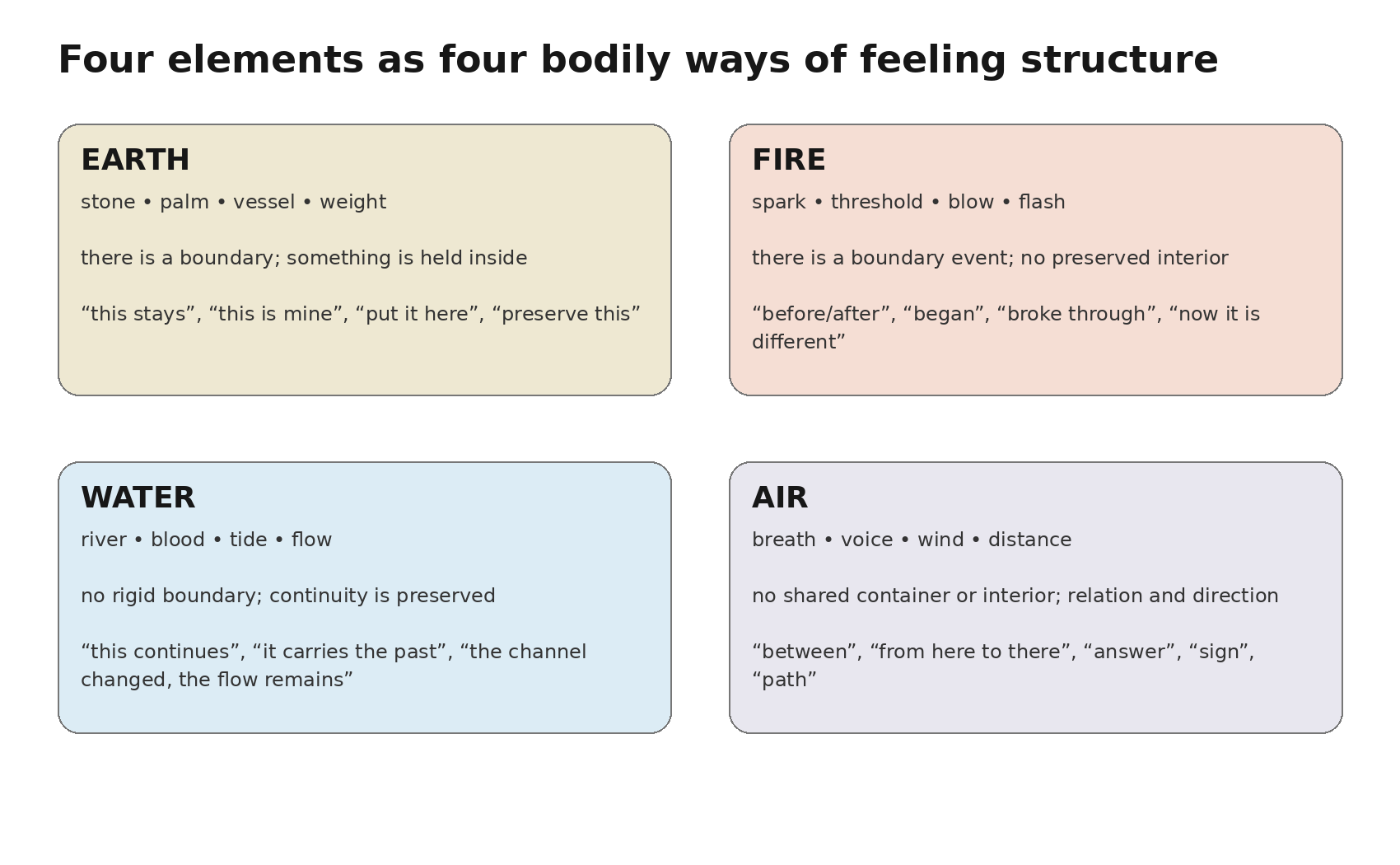
Here the four elements are neither decoration nor a concession to old symbolism. They function as a set of very ancient and highly vivid sensory metaphors. Earth is felt as weight, support, vessel, surface, and boundary. Water as flow, continuity, memory of a path, and the ability to take the shape of a channel. Fire as a flash, a threshold, an event that divides “before” from “after.” Air as breath, interval, voice, distance, direction, and connection between separate points.
The ancient four-element imagery, later alchemical traditions, and various shamanic practices are not one historical system and should not be mechanically collapsed into one another. Yet they share a practical lesson: a natural image can let the body and imagination hold a complex distinction before it becomes a dry term. In this article, the elements are used in exactly this way—as a sensory layer of memory and thought, not as a physical theory of matter.
2. Why introduce a model of four elements
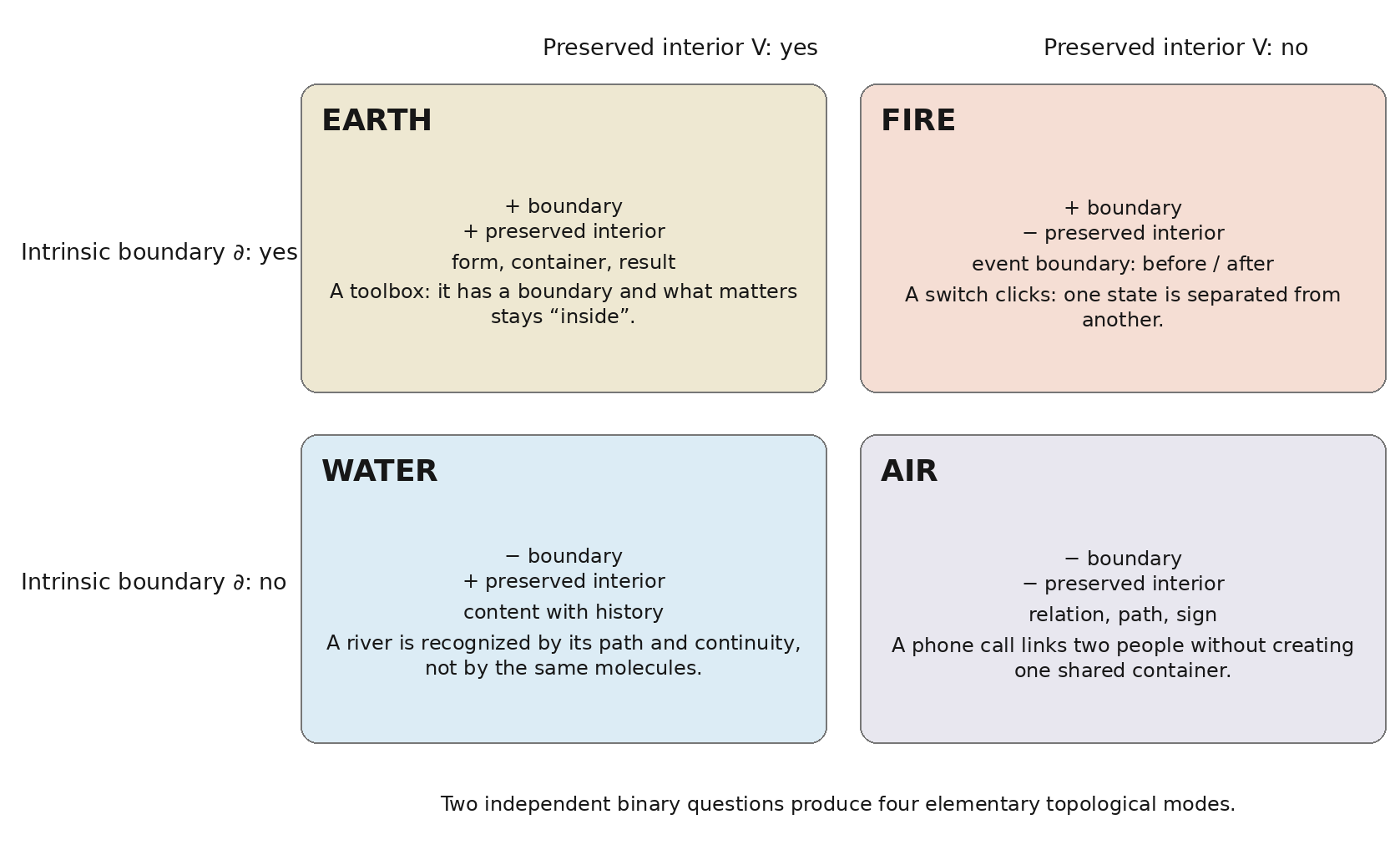
The formal reason is simple: we ask two independent questions about a state or process.
Does it have a boundary of its own—that is, can we distinguish “inside / outside,” “this / not this,” and the beginning and end of a form?
Is some inner state preserved—not necessarily a substance, but whatever carries history, value, filling, or result from one moment to the next?
Two questions, each with a yes/no answer, give four basic modes. At this point the elemental metaphor becomes a working geometry.
Earth: “it holds and contains”
A stone in the palm, a cup, a box, a house, a body, a storehouse, a familiar procedure.
Earth is the mode in which there is a boundary of one’s own and a preserved interior. An object or form is not merely distinct from its surroundings: it holds something. Earth words therefore include “place,” “container,” “one’s own,” “reserve,” “result,” “form,” “value,” and “preserve.”
Importantly, “form” here is not merely an outer outline. It is a reproducible organization by which something can be held, repeated, and recognized. A recipe, a job position, a family ritual, a folder of documents, or a toolbox can all perform an Earth function when the form itself preserves an important result.
Water: “it continues even as the channel changes”
A river, blood, a tide, a stream of people, a melody that remains recognizable in another arrangement.
Water is a mode without a rigid intrinsic boundary but with preserved continuity of state. Water takes shape from a channel or vessel, yet carries the history of its path. Water words therefore include “continuation,” “memory,” “accumulation,” “state,” “trace,” “attachment,” and “living content.”
“Content” should not be understood as a mystical substance hidden inside a form. In ordinary language, it is what makes the form matter at all and what must continue through change. In a family Sunday dinner, the content may be not the soup or the table but the recurring experience “we meet and remain a family.” In a professional tradition, it may be not a specific instruction but the actual capacity to heal, teach, protect, or build.
Fire: “after this, things are no longer as they were”
A spark, a blow, the click of a switch, a leap across a threshold, a shot, a confession.
Fire is the mode of an intrinsic boundary without a preserved interior. It is not a container but an event: it separates the state “before” from the state “after.” Fire is therefore felt most clearly through beginning, breakthrough, initiative, threshold, culmination, and an irreversible gesture.
In narrative, Fire is easy to see wherever a new fact of reality appears: someone says “no,” presses a button, leaves a room, makes an offer, fires a shot, or tries something for the first time. What matters is not the color of the flame but the geometry of the threshold.
Air: “a path has appeared between points”
Breath, voice, smell, a glance, a phone call, an arrow on a sign, a road.
Air is a mode without a shared enclosing container and without a shared preserved interior. Its essence is relation, difference, sign, direction, and a path between separate sides. Air words therefore include “between,” “from here to there,” “answer,” “message,” “comparison,” “model,” “rule,” and “coordinate.”
Two people can be connected by a contract, a question, a route, or a message without forming one physical vessel and without sharing one common “contents.” Air makes distinct sides mutually addressable.
How to use the elements |
3. From four elements to twelve geometries and six axes
An element gives only the basic type of space. To obtain a more precise geometry, the model adds two more dimensions: phase and orientation.
Cardinal phase: a new basis has already appeared—the first step must be made in the new regime.
Fixed phase: the regime is established and reproducible—the question is how it continues stably.
Mutable phase: the old regime still operates, but it must be retuned or transferred into the next one.
Orientation toward others: the result appears in the positions of other participants.
Orientation toward self: the system regulates its own state or its own configuration.
Orientation toward context: participants organize themselves relative to a third object—a goal, standard, object of concern, or image of the whole.
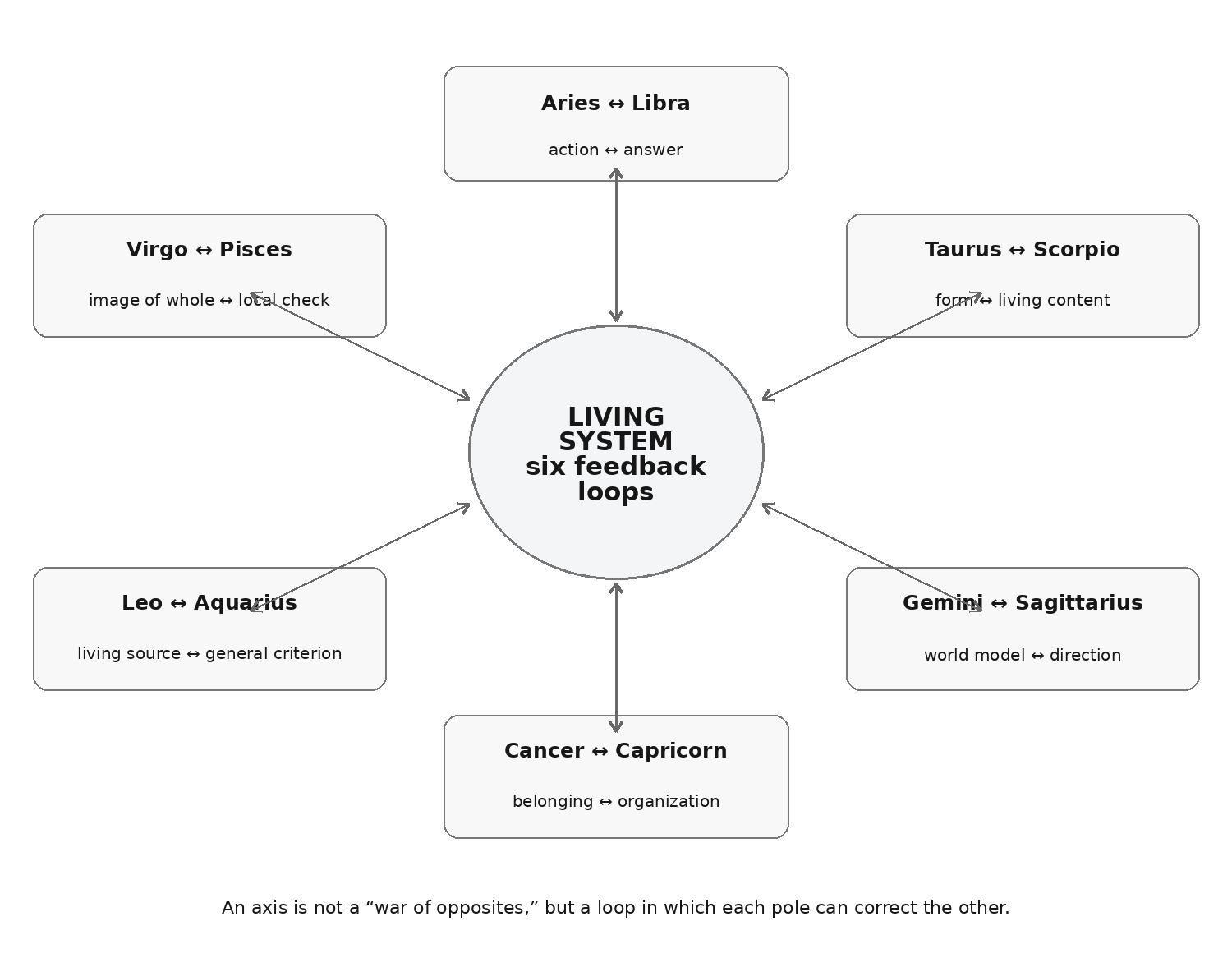
These dimensions produce the twelve sign geometries. For practical learning, however, it is more useful to begin not with twelve separate definitions but with six pairs—the axes. Opposite signs of the same phase answer mutually complementary questions. An axis is not a battle of opposites but a potential feedback loop.
4. Six questions for any living situation
Axis |
What it supports |
Six questions for a situation |
Aries ↔ Libra |
Interaction |
What was done—and what answer can change the next move? |
Taurus ↔ Scorpio |
Continuity |
What are we trying to preserve—and does the old form still carry that value forward? |
Gemini ↔ Sagittarius |
Navigation |
What is our world model—and what continuation from it is relevant to the goal? |
Cancer ↔ Capricorn |
Shared existence |
Who is “we” here—and around what are roles, resources, and responsibility organized? |
Leo ↔ Aquarius |
Transfer of experience |
What actually produces a living result—and what general measure can be extracted from it? |
Virgo ↔ Pisces |
Wholeness |
What can be checked locally—and of what larger whole is this fact a part? |
This table is central. Instead of asking “which axis does this situation belong to?”, it lets us ask six different questions of the same situation. In an ordinary conversation, a family dinner, an investigation, an organization, or a scene in a novel, all six axes may be operating at once.
5. Aries ↔ Libra: action and a real answer
Sensory image: a flash of Fire makes the first cut in the situation; Air brings an answer back across the distance between two sides.
Aries does not mean “aggressiveness.” It is the appearance of the first outward vector: something is done, proposed, begun, or crossed. Libra does not mean “politeness.” It is a form of relation in which the other side’s answer can become a real variable in the next action.
Simple definition |
Three simple examples
A trip for two. — Let’s go out of town tomorrow. — I can’t in the morning. — Then let’s go after lunch. The first move has not disappeared, but the form of the next move changed because of the answer.
A work procedure. A manager introduces a new procedure. People keep making mistakes at the same point. If the manager merely tightens control, the system’s answer has not been accepted. If the procedure itself is changed, Libra has genuinely returned a correction to Aries.
Learning. I try memorizing words with flash cards. A week later I remember ten percent. The result is an answer. If I change the way I study, a working loop appears.
Typical one-sidedness: “I have already decided, but I will let you speak.” Formally there is an answer; geometrically there is not, because it cannot change the path.
6. Taurus ↔ Scorpio: form and living content
Sensory image: Earth is a vessel that holds; Water is a flow that must continue. A good vessel serves the flow. A bad one preserves only its own shell.
This axis is especially difficult because of the abstract words “form” and “content.” In everyday language, it is useful to translate them temporarily as follows:
Form — “how this is arranged so that it can be repeated, held, and passed on.”
Living content — “what, thanks to this form, is supposed to continue and remain important.”
Scorpio’s test — “has the form become an empty shell that now reproduces only itself?”
A very simple example |
Three simple examples
A family tradition. For twenty years everyone gathered at the same table. The house is sold. One can say “the tradition is over,” or notice that what was being preserved was the recurring fact that “we gather”—and find another carrier for it.
A work meeting. When the department had five people, an hour of daily conversation genuinely synchronized the work. With two hundred employees, the same form devours time. The question is not “do we respect tradition?” but “does it still carry the former function?”
A profession. An old master teaches an apprentice an exact sequence of movements. But a new material requires another sequence. If the apprentice understands that what must be preserved is the quality of the joint, not the cult of a particular gesture, the content is transferred into a new form.
Typical Taurus one-sidedness: the form keeps repeating simply because it once worked. Typical Scorpio one-sidedness: everything old is declared dead before we have discovered what in it is still worth preserving.
7. Gemini ↔ Sagittarius: world model and direction
Sensory image: Air carries signals and connects points; Fire turns one possible line into an actual vector of movement.
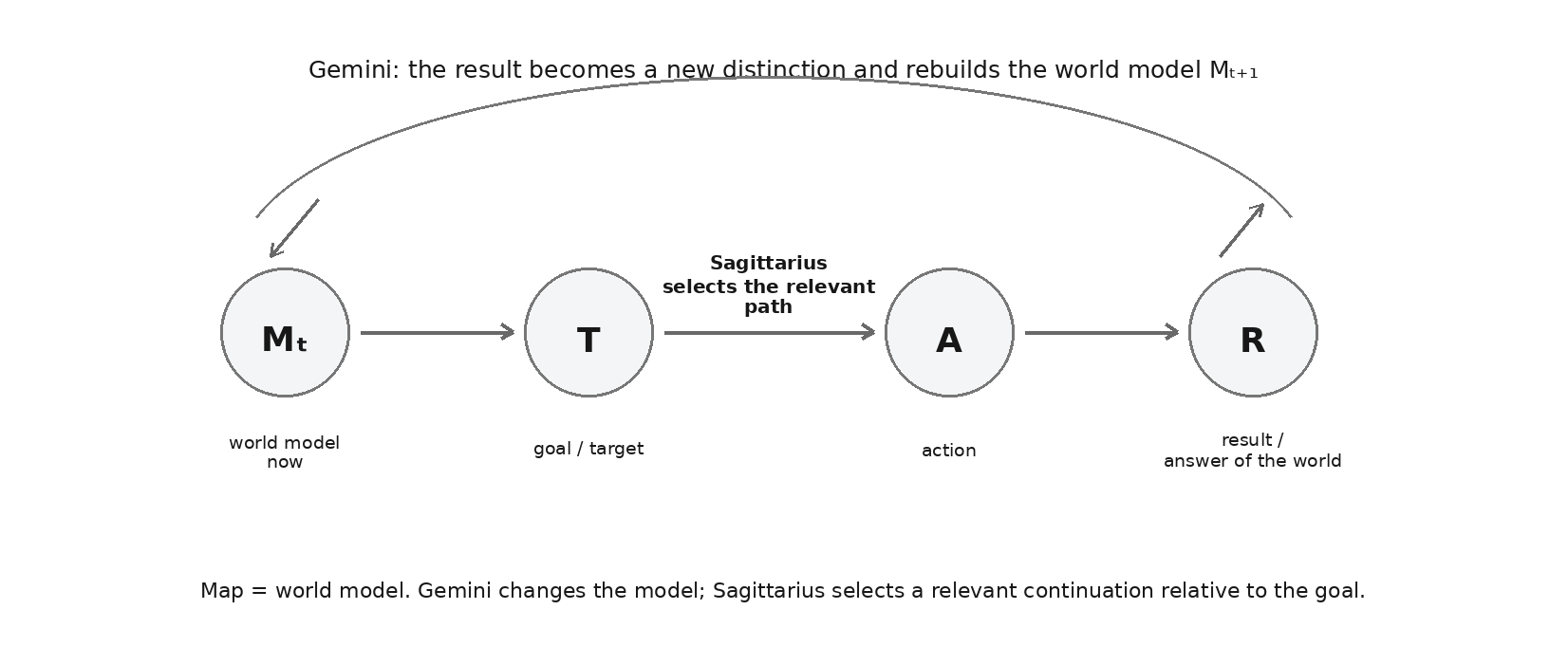
In this article, the word “map” is used simply: map = the participant’s world model. It is not necessarily a picture in the head. It is everything the system distinguishes as existing, connected, possible, dangerous, accessible, probable, and significant.
Gemini changes the world model by comparing partial perspectives: different witnesses, instruments, documents, sensations, and professional languages. Sagittarius asks: which part of this model is relevant to the goal, and what next move makes sense?
Three simple examples
A trip. One road is closed, another is jammed, and the train leaves in forty minutes. Gemini enriches the model. Sagittarius stops collecting data when the goal “arrive today” already yields a clear next step: go to the station.
A sick plant. The leaves are turning yellow. We check water, light, fertilizer, and roots—this builds the model. The next question is not “what else can we possibly learn?” but “what small experiment will best distinguish our hypotheses?”
An investigation. Three witnesses give incompatible accounts. Gemini does not have to choose one “truthful” witness immediately. Sagittarius selects a check that changes the movement of the case—for example, finding out who was actually driving the car.
Typical Gemini one-sidedness is endless expansion of the model: there is always more to know. Typical Sagittarius one-sidedness is choosing the route too early and then seeking new information only to confirm an already chosen direction.
8. Cancer ↔ Capricorn: “we” and object-centered organization
Sensory image: Water gathers into a shared basin and carries a common history; Earth builds supports, shelves, walls, and distributes the load around what must be held.
Cancer is not about emotions in general. It concerns the emergence of a boundary of belonging: who is experienced here as “we,” whose states begin to matter to one another. Capricorn is not about bosses in general. It concerns organization around an object-centered focus: a goal, a child, a project, a home, a resource, a responsibility.
A simple distinction |
Three simple examples
A family. “We are a family” is not yet a division of labor. When a child becomes ill, medicines, money, time, staying home, and calling the doctor all have to be organized. A good structure supports belonging rather than draining one person.
A trip with friends. Five friends go on holiday. Cancer is the feeling “we are going together.” Capricorn is tickets, the car, the budget, the route, and roles. If the organization constantly serves only one person, the “we” itself may disappear after a few days.
A team. People can be declared a department by an order. But a real “we” emerges around a genuinely experienced common task. Capricorn makes it material: decision rights, deadlines, money, responsibility, and access to resources.
Typical Cancer one-sidedness: “we are our own people, we’ll somehow sort it out”—while invisible burdens accumulate. Typical Capricorn one-sidedness: roles and duties continue to exist even though people no longer experience the commonality for which the structure was created.
9. Leo ↔ Aquarius: living source and transferable measure
Sensory image: Leo is a steady hearth that actually gives heat; Aquarius is an airy grid, scale, tuning fork, or coordinate system that lets us compare different hearths and transfer a distinction from one case to another.
This is the axis most easily distorted. If we say “living case ↔ rule,” it sounds as if Leo were merely one example and Aquarius a schoolroom rule. It is more accurate to distinguish four levels.
Concept |
In simple words |
Musician example |
Living source |
Something that can genuinely produce manifestations again and again while regulating itself from within. |
The musician as a working source of performance. |
Manifestation |
A concrete result of the source here and now. |
This phrase played at this concert. |
Case |
A concrete configuration that we observe and compare with others. |
This musician, in this piece, hall, and condition. |
General criterion / rule |
A transferable distinction that can guide us in other cases. Not an order, but a measure. |
For example: a tense phrase sounds better if the resolution is not rushed. |
Why is “living source” more important than the word “example”? Because an example can be a dead snapshot. A hearth is not an “example of heat”—it produces heat every second. A musician does not merely illustrate a musical rule—he or she can generate new performances. An organism does not illustrate living activity—it actively maintains it. Leo as fixed Fire is the stability of precisely such a generative center and the capacity to regulate its manifestation so that the source is not destroyed by its own intensity.
Aquarius as fixed Air makes a different move: it holds a relation or criterion steady enough to work across many separate cases. Here “rule” is better understood not as an order imposed from above but as a measure, coordinate grid, or tuning fork. It lets us ask: is the same distinction appearing here and there?
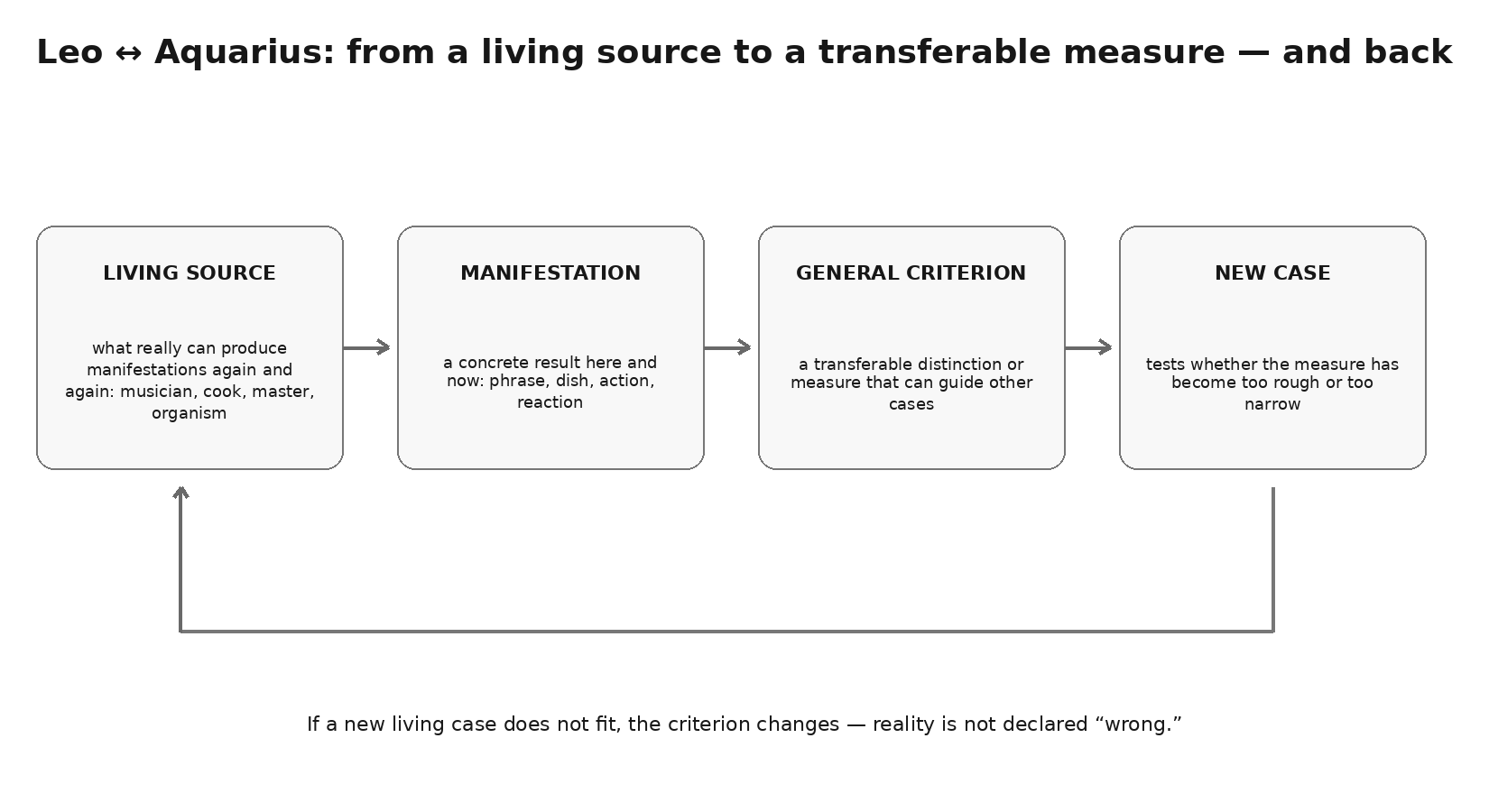
Three simple examples
A cook. A skilled cook can reliably produce good flavor—this is a living source, not one lucky plate. From the cook’s work we may derive a criterion: spices of this type are better briefly heated in fat. A new ingredient turns bitter; therefore the criterion was too broad and needs refinement.
A teacher. A diagram sharply improves one particular student’s understanding. This is a living case. If we conclude “everyone should draw diagrams,” Aquarius has become crude. Several other students reveal where the criterion works—for example, diagrams help when a task is spatial and a student loses the relations among parts.
Sport. A runner can feel pace well enough not to burn out at the beginning and to accelerate near the finish. A coach extracts a transferable measure—for example, a certain relation between breathing and effort. Another athlete shows that the same measure needs adjustment. A rule remains alive only while it returns to living sources.
Two shadows of the axis |
10. Virgo ↔ Pisces: local check and image of the whole
Sensory image: Earth places a concrete piece in the hand that can be checked; Water links pieces into a continuous flow and lets us sense the larger whole to which they belong.
Virgo does not mean “pettiness.” It is the capacity to check a local section: does the detail work, is the measurable fact correct, which exact piece of form should be carried forward? Pisces does not mean “vagueness.” It is the capacity to hold an image of the whole while the separate fragments are not yet fully connected by a causal map.
A simple formula |
Three simple examples
A doctor. Temperature, a laboratory test, and an image scan are local checks. But the doctor must hold an integral hypothesis: what is happening to the person? A good hypothesis does not replace the test; it tells us which test will actually distinguish the alternatives.
A car. A mechanic checks the battery, starter, fuel, and wiring. This is Virgo. Pisces holds the whole: “why does the starting system as a whole fail to enter its working state?” The image of the whole suggests the next local test.
A novel. A writer senses: this book is about returning to a past that continues to live. That is the whole. The Virgo question is: what concrete gesture in a scene will let the reader feel this without explanation? For example, a neighbor still places a chair by the spot where a long-demolished gate once stood.
Typical Virgo one-sidedness: an endless catalog of correct details with no answer to “what does all this mean together?” Typical Pisces one-sidedness: a beautiful whole that cannot be distinguished from another beautiful version by any test.
11. One situation—all six axes at once
To feel the system as a whole, it helps to stop asking “which axis is the main one here?” Let us take the preparation of an ordinary dinner. The same situation simultaneously has all six dimensions.
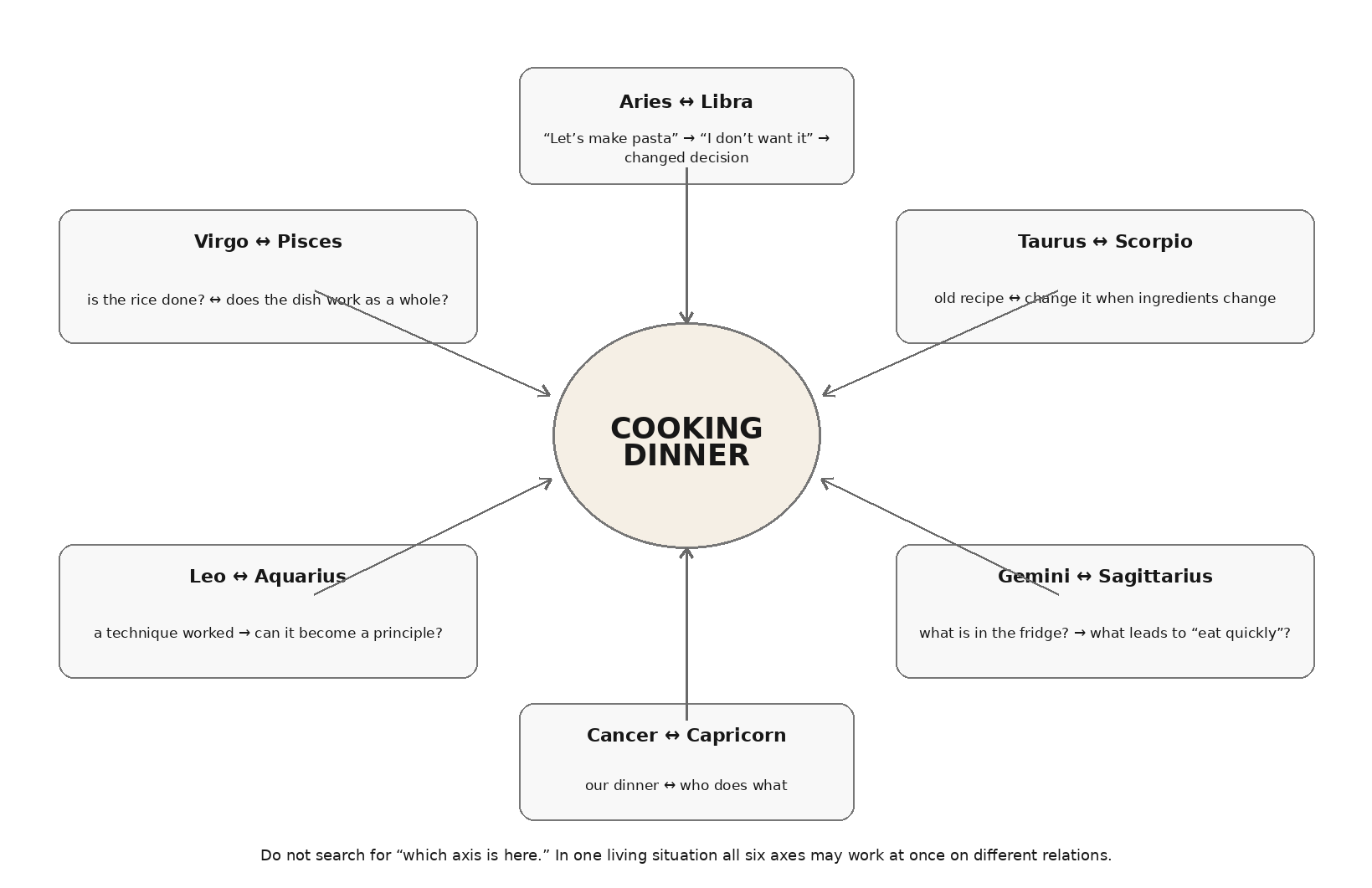
Aries–Libra notices the proposal and the answer. Taurus–Scorpio sees the old recipe and the need to change it for new ingredients. Gemini–Sagittarius sees what is in the refrigerator and what leads to the goal “eat quickly.” Cancer–Capricorn sees “our dinner” and the distribution of roles. Leo–Aquarius sees a technique discovered by chance and asks whether it can become a transferable principle. Virgo–Pisces asks whether this particular rice is done and whether the dish works as a whole.
This way of seeing matters: the axes do not divide reality into six boxes. They provide six independent questions for one system. A scene in a novel, a negotiation, or one’s own learning may therefore contain several axes at different levels at the same time.
12. How an axis develops: from monologue to learning
The earlier formula “axis absent / axis present / axis recursive” is too coarse. But a seven-stage scale can easily become another table to memorize. For practice, five clear states are enough.
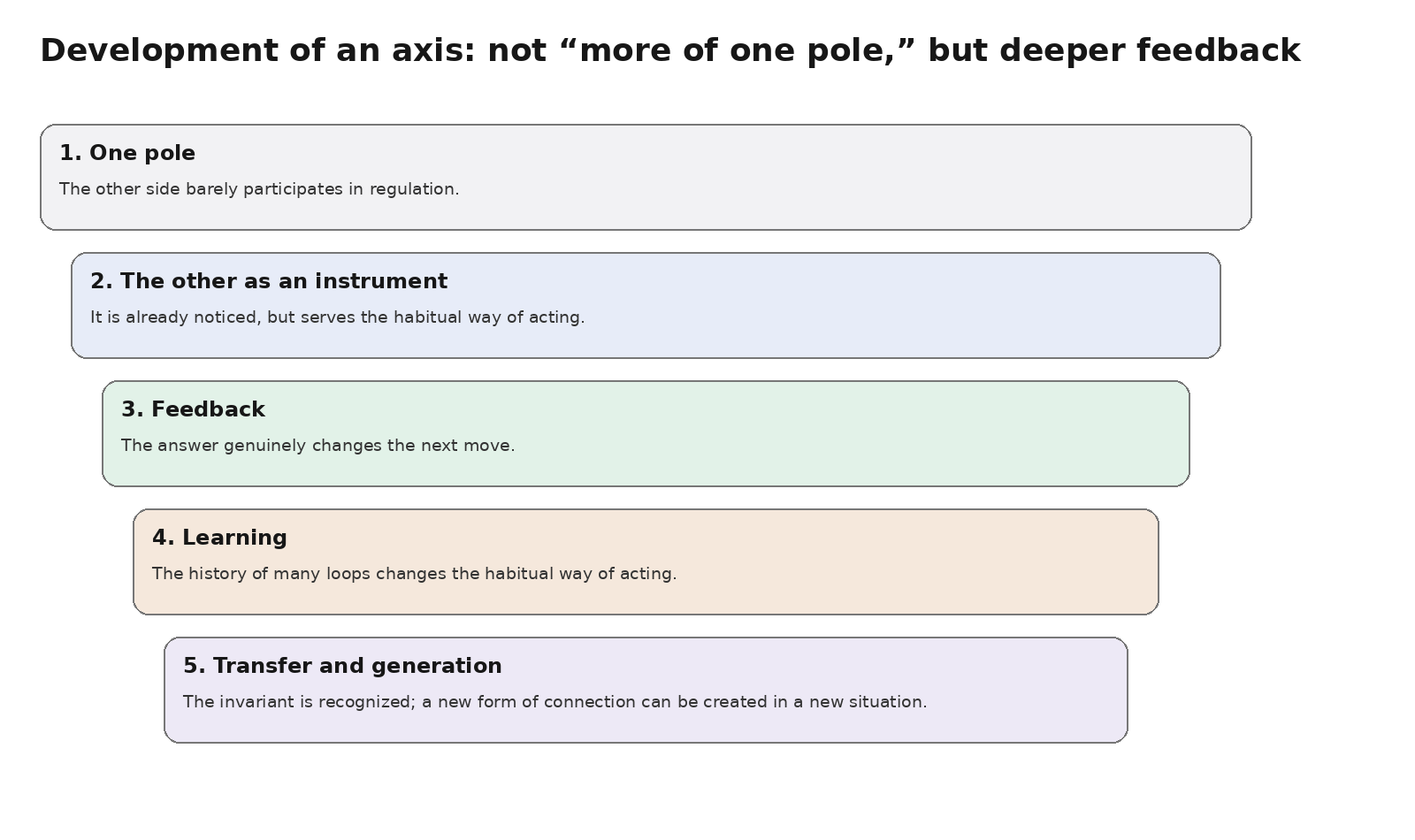
1. One pole determines almost everything
The other pole is either unnoticed or treated as an obstacle. “I have decided—the others will adapt.” “We need more information.” “There is a rule—the case must fit it.” The system does not yet recognize the other side as an equal source of correction.
2. The second pole is used as an instrument
It is already useful, but it serves the original mode. “I will listen to you so I can persuade you better.” “I will collect data that support the chosen path.” “We will look at exceptions, but we will not change the rule.” This is more complex than a blind spot, but there is still little genuine mutual change.
3. Genuine feedback appears
The opposite pole can change the next move. I proposed—received an answer—changed the proposal. I built a model—chose a route—the result changed the model. I derived a criterion—a new case did not fit—the criterion was refined.
4. Learning appears
The history of many cycles changes not only the next decision but the habitual way decisions are made. A manager realizes that projects are repeatedly shown to the team too late and redesigns the discussion procedure itself. A researcher realizes which type of data is usually critical and looks for it earlier.
5. Transfer and generation appear
The system now understands the invariant of the axis and can create a new form of connection in an unfamiliar situation. A person does not merely know how to “negotiate using a familiar template” but can invent a procedure in which both sides have a real right of reply. A tradition does not merely modify an old ritual but creates a new carrier for what truly needs to be preserved.
Recursion does not yet mean development |
13. What the five stages look like on each axis
Aries ↔ Libra. “I decide” → “I ask so I can get my way” → “your answer changes my move” → “we change the way we make decisions” → “in a new situation we create a new procedure in which both sides can genuinely influence the outcome.”
Taurus ↔ Scorpio. “That is how it has always been” → “sometimes we allow an exception” → “the form changes when it stops carrying what matters” → “we understand what the invariant actually was” → “we can create entirely new carriers for that invariant.”
Gemini ↔ Sagittarius. “More data” or “I already know the way” → “I seek information for the chosen path” → “model and direction correct each other” → “I learn to recognize what amount and kind of data is usually sufficient” → “for a new type of task I create new questions and new ways of observing.”
Cancer ↔ Capricorn. “We are one of us” or “here are the roles” → “belonging is used to impose duties” → “the structure genuinely changes in response to the state of the ‘we’” → “the group learns from its history of conflicts how to distribute the load” → “it can create a new type of organization for a new kind of ‘we’.”
Leo ↔ Aquarius. “My way is right” or “the rule comes first” → “exceptions are allowed but change nothing” → “living source and general criterion correct each other” → “we learn how to build better criteria” → “we create a new system of distinctions when the old categories no longer work at all.”
Virgo ↔ Pisces. “Only details” or “only the whole” → “details merely confirm the preferred picture” → “the whole proposes a test, and the test changes the whole” → “we learn to choose checks that genuinely discriminate between competing wholes” → “accumulated facts let us generate a new image of the whole.”
14. The axes as one living machine
We can now assemble the six axes not as a list but as one overall process. This is a working synthetic scheme, not a claim that real processes must proceed in exactly this order.
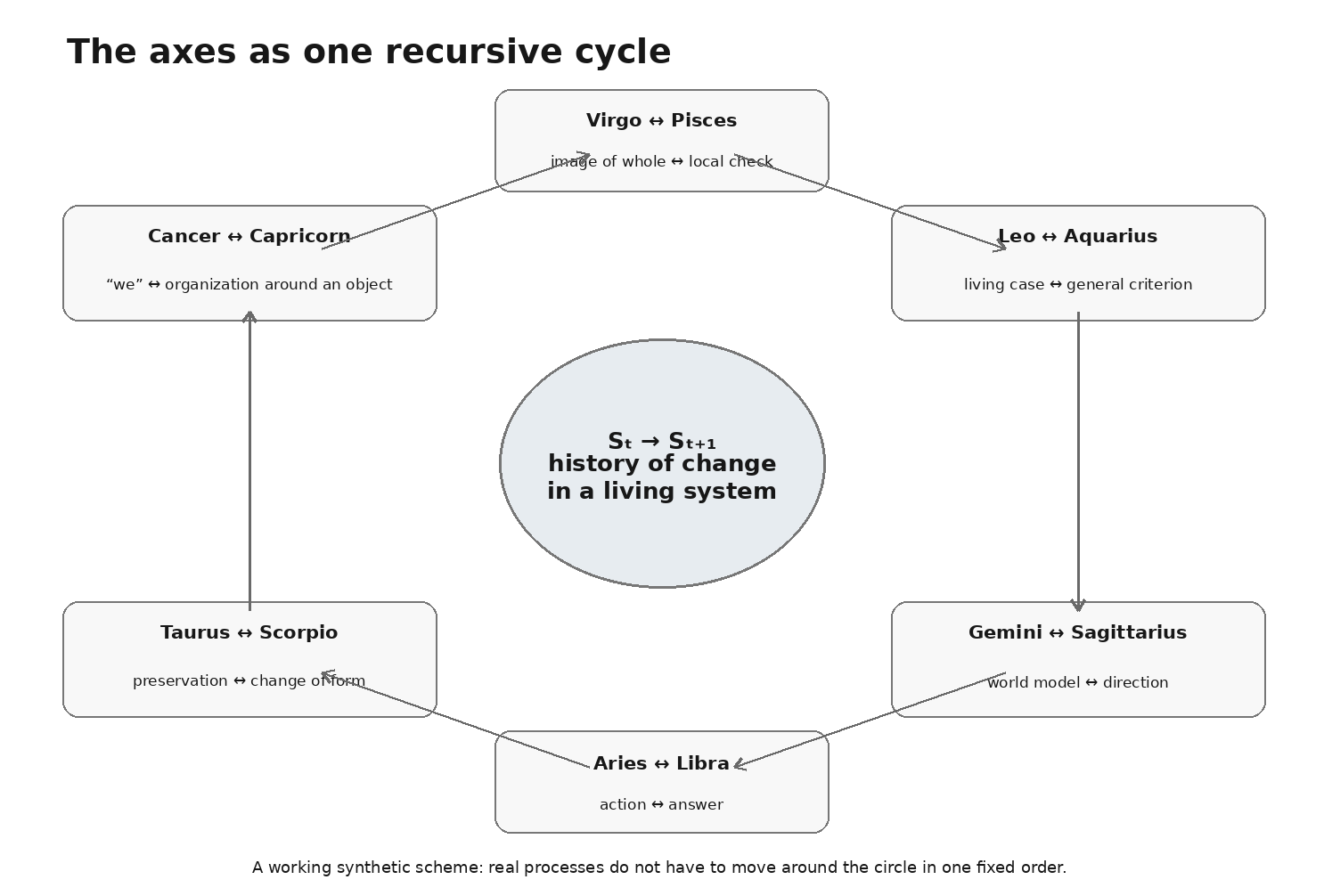
A system has some state. It acts and receives an answer—Aries–Libra. The answer changes the available distinctions and the world model—Gemini–Sagittarius. Experience accumulates and raises the question of which forms still carry what matters—Taurus–Scorpio. Shared life redistributes belonging, roles, and responsibility—Cancer–Capricorn. Particular working manifestations provide material for general criteria, and the criteria return to new living cases—Leo–Aquarius. Local checks confirm or restructure the image of the whole—Virgo–Pisces. After this, the system is no longer quite the same as it was at the beginning.
15. How to learn the system without overload
For practice, there is no need to name all twelve signs, planets, phases, and orientations every time. Take one ordinary situation and ask the six questions. One good example that can be felt in the body is better than twenty classifications.
1. Aries–Libra: what was done, and what answer could genuinely change what happened next?
2. Taurus–Scorpio: what was being preserved, and has the old form become empty?
3. Gemini–Sagittarius: what is the world model, and what next step is relevant to the goal?
4. Cancer–Capricorn: who is “we” here, and around what object are roles and resources distributed?
5. Leo–Aquarius: what actually produces the result, and what transferable measure can be derived from it?
6. Virgo–Pisces: what can be checked locally, and how does it change the image of the whole?
Then return to the elements. Not as an exam, but as a bodily check: where is the vessel and what does it hold? where is the flow and its history? where is the “before/after” threshold? where is the interval, connection, or direction? This double work—a formal question plus a sensory image—gradually makes the system not merely remembered but recognizable.
16. A short map for review
Axis |
Sensory image |
What it supports |
Working loop |
Main error |
Aries ↔ Libra |
flash ↔ answer across distance |
interaction |
move → answer → changed move |
the answer is decorative |
Taurus ↔ Scorpio |
vessel ↔ flow |
continuity |
form → state of content → new form |
confusing the form with what it is for |
Gemini ↔ Sagittarius |
wind/signals ↔ arrow |
navigation |
model → direction → result → model |
there is never enough data, or the path is chosen too early |
Cancer ↔ Capricorn |
shared water ↔ supports around an object |
shared existence |
“we” → structure → experience of “we” → structure |
belonging without responsibility, or roles without belonging |
Leo ↔ Aquarius |
hearth ↔ tuning fork/grid |
transfer of experience |
source → manifestation → criterion → new case |
“it works for me” = law, or rule above the living |
Virgo ↔ Pisces |
piece in the hand ↔ flow of the whole |
wholeness |
whole → local test → result → new whole |
details without meaning, or a whole without testing |
Conclusion
The system of axes becomes coherent when it stops being a table of character types or six separate topics. The four elements give the body four simple ways to distinguish structure: Earth holds, Water continues, Fire crosses a threshold, Air connects. From these basic modes, phases, and orientations arise twelve geometries; opposite geometries form six loops.
Each loop supports a particular form of viability: interacting, preserving continuity, navigating, forming a shared “we,” carrying living experience into general knowledge, and keeping the relation between part and whole. Development of an axis does not mean “having both poles in equal measure.” It means allowing the opposite pole to genuinely change the next move, learning from the history of such changes, and in new conditions creating a new form of connection without losing the invariant.
In this form, the axes can be recognized not only in literature. They are visible in conversation, family life, work, learning, craft, organization, an organism, and one’s own thinking. That is what makes the system not a classification but a working geometry of processes.